
Most freshers do have work experience. They just do not call it that. A summer in a family shop, three months helping at a front desk, a weekend tutoring job, a small freelance gig for a real client, a final-year project that a local business actually used — all of it is work, and all of it can go on a resume. The problem is rarely that there is nothing to write. The problem is knowing how to describe work experience freshers can honestly claim, in words an employer trusts, without inventing a job that never existed.
This guide is about the wording, not the inventing. You will learn a simple formula — verb, task, tool, result — and how to apply it to the four kinds of experience a fresher usually has: part-time work, freelance work, an internship, and project work. You will see how to handle a short job without hiding its dates, how to describe an unrelated job by naming the transferable part instead of the title, and how to choose honest titles that help rather than mislead.
Then you will watch the whole thing in action: one fresher, Jordan Lee, with the same short work history rewritten for two different target jobs, a data-focused role and a customer-facing one. By the end, you will know how to describe work experience freshers gain in part-time jobs, internships, and college projects — without overstating any of it.
No invented percentages, no guaranteed outcomes, just a method you can repeat for every application. It is, in short, a complete answer to the question of how to describe work experience freshers already have, in words an employer can trust.
One thing to settle before the first bullet: describing experience well is not the same as dressing it up. An employer reading a fresher resume expects a short history. What they are checking is whether the person in front of them is honest about it, whether they understood what they were doing, and whether they can explain it clearly. A plain, specific bullet beats a grand, vague one every time, and the rest of this guide shows you how to write the plain, specific kind. That distinction is where how to describe work experience freshers should start: with honest work, written plainly.
Table of Contents
What Counts as Work Experience When You Have Little of It
Start by listing everything you have actually done, before you decide what counts. Most freshers throw away half their history before they write a word, because they measure it against a full-time office job and find it wanting. That is the wrong test. The right test is simpler: did someone rely on you to do something, on a schedule, with a result they could see? If yes, it is experience, and learning how to describe work experience freshers already have starts with recognising it. That recognition is the first skill in how to describe work experience freshers can honestly claim, and it comes before a single bullet is written.
Part-time work counts, whether it was a shop floor, a café, a call centre, or a campus job. So does seasonal work, a summer job, and a short contract that lasted a few weeks. An internship counts, paid or unpaid, as long as you did real tasks. Freelance work counts when there was a real client and a real deliverable, even if it was one client and one small job.
Project work counts when it solved a real problem for a real user, which includes a final-year project built for a local business, a website built for a family shop, or a small app used by a student society. A campus role counts when it involved responsibility — running an event, managing a budget, keeping records for a club. Family business work counts when you did real tasks on a real schedule, and it should be labelled honestly as such, with the word informal or family business where that helps the reader. Knowing what counts is the starting point for how to describe work experience freshers can stand behind.
What does not count is just as important to know. A course you finished is not work experience, though a courses and certifications entry can sit elsewhere on the page and support a short work entry by showing you had the skill before you used it. A hobby is not work experience unless it produced something for someone else. Watching videos about a skill is not experience with it. A group assignment where you did nothing is not experience, and claiming a share of it is the fastest way to fail an interview question about it. And a job you applied for but never started is not experience at all.
There is a useful line here, and it is worth drawing honestly. Snow Resume’s guide to writing a resume with no experience makes the same point from the other side: build from study, projects, volunteering, family business, caring and household responsibilities, sport, clubs and self-taught skills, give each a title and dates and a line about what was achieved, and list it honestly — informal is fine, invented is not. That is the standard this guide uses throughout: if you did it, describe it well; if you did not do it, leave it off.
You can read their full guide at Snow Resume’s no-experience guide for a second view of what counts, and a second opinion on how to describe work experience freshers can list honestly, though the wording method below is the part most guides leave out.
Once you have the list, sort it by relevance to the job, not by how impressive it sounds. A three-month café job that taught you to handle forty customers an hour is more useful for a customer-facing role than a one-week shadowing visit to a big company. A small freelance website you built and handed over is more useful for a junior web role than a month of filing in an office. Relevance decides the order, and the wording formula decides how each entry reads — which is why the next section, on how to describe work experience freshers can make count, matters more than the list itself.
The Wording Formula: Verb + Task + Tool + Result
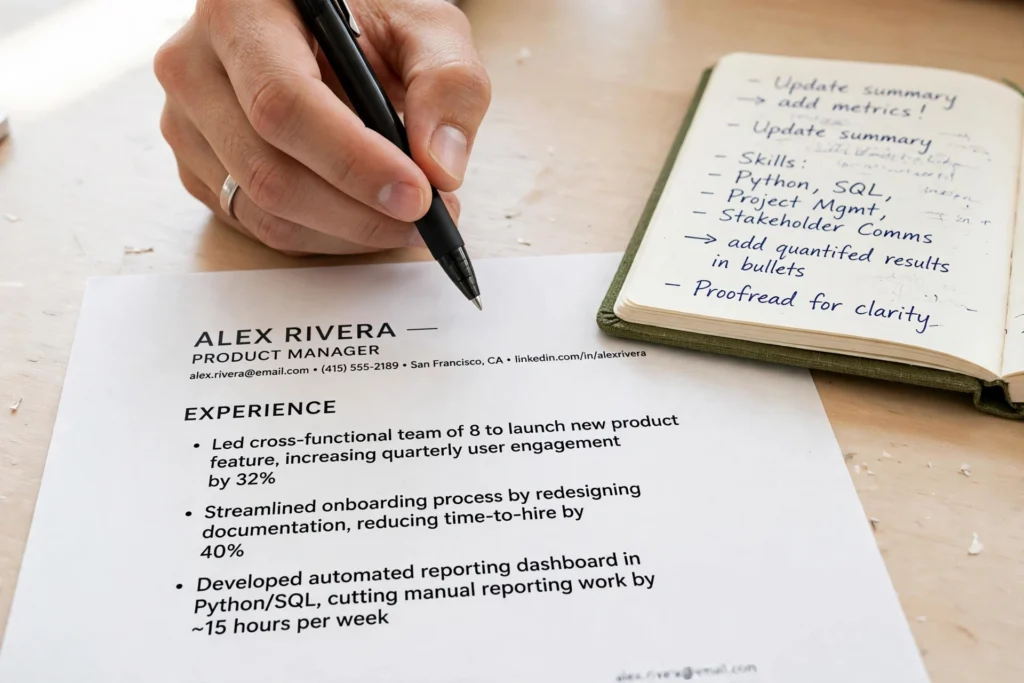
Every good work experience bullet follows the same shape, whether the job lasted three years or three weeks — and the shape is what turns a duty into work experience bullet points an employer can check: a verb, a task, a tool, and a result. The verb says what you did. The task says what it was about. The tool says how you did it. The result says what changed because you did it. Four parts, one or two lines, and the reader knows what happened without having to guess. That shape is the whole method this guide teaches for how to describe work experience freshers can turn into evidence.
Take a vague bullet first: “Worked in a shop and helped customers.” That tells the reader almost nothing. Now the same work through the formula: “Served 30 to 40 customers per shift at the till, using the shop’s point-of-sale system, and handled cash and card payments with no end-of-day shortages over three months.” Same job, same person, same three months — but now the reader knows the scale, the tool, and the result, and that is the difference between a duty and a piece of evidence. It is also the clearest single example of how to describe work experience freshers often understate: the facts were always there, the wording was not.
The verb matters most, because it is the first word the reader sees and it sets the level of the work. “Helped with” and “worked on” say nothing. “Served”, “organised”, “built”, “answered”, “tracked”, “prepared”, “resolved” say something. If you are short on strong verbs, the guide to resume action verbs for freshers has a full list with examples, and it is worth reading once before you write your bullets — but keep the verb list brief here, because verb choice is that guide’s job, not this one.
Pick the verb that matches what you actually did, and do not borrow a verb that belongs to a bigger job than yours. That discipline is part of learning how to describe work experience freshers can defend in an interview.
The task is the middle of the bullet, and it should name the real thing, not the category. “Handled customer queries” is a category. “Answered product and delivery questions from walk-in customers and by phone” is the real thing. The difference is small on the page and large in the reader’s mind: the specific version lets them picture the work, and picturing the work is what makes them believe it. Specific tasks are what make how to describe work experience freshers write about feel real instead of rehearsed.
The tool is the part freshers most often leave out, and it is the part that connects your experience to the job ad. The tool can be software — a spreadsheet, a point-of-sale system, a ticketing system, a design program — or it can be a method, a piece of equipment, or a language. Naming the tool does two things at once: it proves you have touched the kind of thing the job uses, and it gives the software that scans resumes a keyword to match.
Name the tool you actually used, at the level you actually used it, and say nothing more. The tool is often the detail that decides how to describe work experience freshers can connect to the job ad in front of them.
The result is the part that most often gets invented, so it needs the most care. A result is something that changed because of your work, and it has to be one you can defend in an interview. “Reduced waiting times” is a claim you would need to prove. “Kept the morning queue moving so no customer waited more than a few minutes during the busy period” is a description of what you did, and it is honest. Getting the result right matters most when you are learning how to describe work experience freshers have done in short or part-time roles, because the result is the part the reader checks.
If you have a real number — customers per shift, orders processed, files organised, students tutored, a deadline met — use it, because numbers make a bullet concrete. If you do not have a number, do not invent one to fill the slot.
A bullet without a number is still a good bullet if the verb, task, and tool are specific, and that is a rule worth remembering when you are deciding how to describe work experience freshers can put numbers to. The guide to work experience bullet points for a resume with no experience from OwlApply makes the same point well: the formula is a verb, the thing done, and the number it produced — and where the number does not exist, the honest move is to describe what would have been different if the work had been done badly.
One Honest Number Where It Exists
Numbers help, but only real ones. Here is a quick test before you put a number in a bullet: could you explain, in one sentence, how you know it? If you counted the customers yourself, kept the record, or saw the total on a report, you know it. If you are guessing, rounding up a guess, or borrowing a number from a colleague’s work, you do not know it, and it should not be on the page. Employers do ask about numbers in interviews, and a number you cannot explain is worse than no number at all. That is the test to run on every figure before you decide how to describe work experience freshers can measure honestly.
Good numbers for a fresher are small and ordinary: shifts per week, customers per shift, orders packed per day, calls answered, files sorted, students tutored, hours volunteered, items counted in a stock check, days a project ran, a deadline met. None of these need to be large to be useful. Thirty customers a shift is a real number. So is twelve orders a day.
What makes them work is that they are yours, and that they give the reader a sense of scale. Small, real numbers are the safest way to learn how to describe work experience freshers can quantify without inventing. A bullet that says “tutored two students in maths, twice a week for a term, and both improved their test scores” is stronger than a bullet that claims a percentage improvement you never measured, and it is stronger precisely because it is modest and checkable.
If a bullet ends without a number, ask the question OwlApply suggests: what would have been different if you had done the job badly? If the answer is “customers would have waited longer”, write that. If the answer is “the shelves would not have been stocked before opening”, write that. The result does not have to be a number to be a result. It has to be a change, and it has to be true.
How to Describe a Part-Time Job on Your Resume
A part-time job is the most common kind of experience a fresher has, and the easiest to under-describe — which is why learning to describe part-time job on resume entries properly is worth the effort. The usual mistake is to write the job title and stop, or to list duties in the dullest possible words: “responsible for customer service, cleaning, and stock.” Nobody learns anything from that. The fix is to pick the two or three tasks that took most of your time, and run each through the formula — the same formula this guide to how to describe work experience freshers uses for every kind of entry that follows.
Here is a part-time shop job, first the weak way, then the right way. Weak: “Sales Assistant, City Mart, June to August 2025. Responsible for customers and stock.” Better: “Sales Assistant (part-time), City Mart, June to August 2025. Served 30 to 40 customers per shift at the till using the point-of-sale system, handling cash and card payments. Restocked shelves each morning from the delivery list and checked expiry dates, so the shop opened on time every day. Answered product questions and directed customers to the right aisle, including during the busy weekend rush.”
Three things changed, and they show how to describe work experience freshers often leave vague. First, the title says part-time in brackets, so the reader knows the shape of the job at a glance. Second, each bullet has a verb, a task, a tool, and a result. Third, nothing is exaggerated: the job is still a shop job, but it now reads as a job done properly, which is exactly what an employer wants to see from a fresher.
Part-time wording also needs a decision about dates, and the rule is simple: show them plainly. “June to August 2025” is a complete, honest date range. Do not stretch it, do not hide the end date, and do not write “2025 to present” for a job that ended. A short, finished job is not a problem. A date range that does not add up is a problem, because it is the first thing a careful reader checks — and honest dates are part of how to describe work experience freshers can be trusted to have done.
One more point about part-time work: separate it from unpaid work on the page. Volunteer roles, club roles, and unpaid help belong under their own heading or clearly marked as volunteer, so the reader can tell what was paid employment and what was not. The guide to volunteer and part-time work on a fresher resume shows how to draw that line, and it is worth following — mixing paid and unpaid entries under one heading without labels is one of the small confusions that makes a reader trust the page less.
Part-time work is also the right place to compare with internship wording, because the two look similar on the page and the difference matters. A part-time job is usually about keeping an operation running: serving, stocking, answering, cleaning, delivering. An internship is usually about learning a function: analysing, drafting, testing, reporting, supporting a team. The verbs are different because the work is different, and the guide to how to update your resume after an internship ends shows how an internship entry is kept current once the role is over — the same habit of plain dates and honest verbs applies to part-time entries too.
How to Describe Freelance Work on a Fresher Resume
Freelance work is real work, and it deserves a proper entry, but it needs more care than a part-time job because there is no employer name to lean on. The reader cannot picture the workplace, so your entry has to do that job for them: who the client was, in general terms, what you delivered, and what happened with it. That extra context is what makes how to describe work experience freshers do as freelancers believable: the reader needs a client, a deliverable, and an outcome.
Never name a private client without their permission. Describe them by type instead: “a local café”, “a small online shop”, “a student society”, “a family-run business”. That is enough for the reader and fair to the client. Then give the deliverable and the result: “Designed a four-page website for a local café using WordPress, including the menu and opening hours, and handed it over with a short guide so the owner could update it. The site has been live since March 2026 and the owner uses it for all new menu changes.”
The honest title for freelance work is “Freelance” followed by the skill: “Freelance Graphic Designer”, “Freelance Web Designer”, “Freelance Tutor”, “Freelance Writer”. Do not invent a company name, do not call yourself the founder of a studio that was really just you and a laptop, and do not list a client as an employer.
“Self-employed” is also honest, and it is the framing Toptal recommends in their entry-level guide: personal projects and freelance gigs framed as self-employment with real clients, where the resume is about transferable skills and achievements, not the titles held. That framing is the idea behind how to describe work experience freshers do as freelancers: the work matters more than the label. Their full guide to entry-level resumes with little or no experience is worth reading for the framing, though the bullets below are the part that makes the framing believable.
A freelance entry should also show that the work ended properly. Clients care about delivery, and employers reading your resume care about the same thing: did you finish it, hand it over, and leave the client able to use it? A bullet that says what you delivered and that the client still uses it says more about reliability than any adjective could. A finished, usable delivery is what turns a small gig into proof, and it is one of the clearest ways to show how to describe work experience freshers have done for real clients.
If you have only one freelance client, one entry is enough, and it should not be padded into three. Two or three bullets, each with a verb, a task, a tool, and a result, will do — and that is enough, because how to describe work experience freshers do as freelancers is about proof, not volume. If you have several small clients, group them under one freelance entry rather than listing each one separately, and name the range of work: “Completed five small design jobs for local businesses between January and June 2026, including menus, posters, and social media images, all delivered on the agreed date.”
How to Describe an Internship on Your Resume
An internship is the easiest kind of little experience to describe well, because it usually has a real employer name, real dates, and real tasks. The mistake freshers make with internships is the opposite of the part-time mistake: instead of under-describing the work, they over-describe the company and under-describe themselves. A paragraph about how large the company is tells the reader nothing about what you did there.
Write the internship the same way as any other job: title, employer, dates, then two to four bullets through the formula. Internships are the simplest case of how to describe work experience freshers can write with confidence, because the employer, the dates, and the tasks are all real and checkable. The title should say Intern, or the actual role title with Intern in brackets, and it should never be inflated. “Marketing Intern” is honest. “Marketing Executive” for a six-week internship is not, and it will be found out in the first interview question about the role.
Here is an internship entry done properly: “Marketing Intern, Brightline Media, June to July 2026. Drafted six social media posts a week in Canva and scheduled them in the team’s planner, following the brand guide for tone and images. Collected weekly engagement numbers into a spreadsheet for the team meeting, so the team could see which posts worked. Answered customer messages on the company inbox during the morning shift, and passed anything urgent to the supervisor the same day.”
Notice what the entry does not claim. It does not say the intern ran the campaign, grew the audience, or managed the account. It says what the intern actually did: drafted, collected, answered, passed on. That is plenty. An employer reading it can see a person who did real tasks, on a schedule, with a supervisor, and that is what an internship is supposed to prove. It is a good model for how to describe work experience freshers can copy for other entries: real tasks, a schedule, a supervisor, and nothing claimed beyond that.
An unpaid internship is still an internship, and the entry works the same way. Do not hide that it was unpaid if the reader would reasonably assume it was paid — a single word in brackets, “unpaid”, keeps it honest — and do not apologise for it. The work is the work, and the bullets are what matter. What to do with the entry once the internship ends, including when to keep it, when to shorten it, and when to move it down the page as newer experience arrives, is covered in the guide to how to update your resume after an internship ends, which is the natural next read once the entry is written.
How to Describe Project Work on Your Resume
Project work is the experience most freshers have the most of and describe the worst. The usual version is a line in a projects section that says what the project was — “Built a library management system using Python” — and nothing about who used it, what it did, or what you learned from building it. That is a description of a school assignment, not a piece of work experience, and it will not convince anyone. Learning how to describe work experience freshers gain from projects means giving the project a user, a tool, and an outcome — not just a topic.
The fix is to treat a project like a job entry: give it a role, a date range, and two or three bullets through the formula. The role is usually “Developer”, “Designer”, “Team Lead”, or simply “Final-year project”, with your actual contribution named plainly. The dates are the months you worked on it. The bullets say what you built, with what tool, and what happened when someone used it.
Here is a project entry written as experience: “Final-year project: booking system for a local dental clinic, January to May 2026. Built the booking form and appointment list in Python with a simple database, so the clinic could take bookings without phone calls. Tested the system with the receptionist over two weeks and fixed the double-booking fault she found. Wrote a one-page user guide so the staff could use it without help.”
Three things make that entry work. First, there is a real user, the clinic, so the reader can see the work mattered to someone. Second, the bullets name the tool and the result, not just the topic. Third, the entry admits a fault was found and fixed, which is honest and, paradoxically, more convincing than a claim that everything worked first time. Employers know that real work involves fixing things. Saying so proves you have done real work, and it is one of the strongest habits in how to describe work experience freshers can show as project work.
Project work also needs the skills connection kept short. A project proves a skill, but the proof belongs in the bullet, not in a long explanation of the skill itself. If you want the full method for writing the projects section itself — where it goes, how many projects to include, and how to choose between them — the guide to the projects section student resume no experience covers it in detail, and this post does not repeat it. What matters here is the wording: verb, task, tool, result, with a real user and an honest outcome.
A final note on projects: do not list every project you have ever done. Two or three strong ones, each with a real user and a real result, beat six one-line descriptions. Choose the projects closest to the job you want, and let the rest go. A resume is not an archive. It is a case for hiring you, and every entry has to earn its place.
How to Describe a Short Job Without Hiding the Dates
A job that lasted a few weeks, a season, or one summer worries freshers more than any other entry, because they assume the reader will see the short dates and think they were fired or gave up. The opposite is usually true: a short, finished job with plain dates reads as honest, and a short job with fudged dates reads as a problem. The dates are not the issue. Hiding them is — and plain dates are a basic part of how to describe work experience freshers can be trusted to have done.
Show the dates exactly as they were: “June to August 2025”, “December 2025”, “three weeks in July 2026”. If the job was seasonal, say so in the title or the first bullet: “Seasonal Sales Assistant”, or “hired for the summer season”. Seasonal work has a built-in explanation for its length, and naming it removes the question before it is asked. If the job was a fixed-term contract, say that too: “three-month contract”. A contract that ended is not a job you left. It is a job you finished.
Then say what the short stay proves, because a short job does prove something. A person who worked a full summer in a busy shop proved they can keep a schedule, handle customers, and finish what they started. A person who did a three-week stock check proved they can learn a system fast and work carefully under a deadline.
The bullets should make that proof visible: “Learned the till system in the first two days and worked the morning shift alone by the end of the first week” says more about reliability than any claim about commitment. A short job described this way answers how to describe work experience freshers worry about most: the fear that a few weeks of work looks like nothing.
What a short job should never do is borrow length from another job. Do not merge two short jobs into one entry. Do not extend the end date by a month to make it look longer. Do not drop the dates entirely and hope nobody notices, because the first question in an interview will be about the dates, and you will have to explain them anyway. Explain them on the page, in plain words, and move on. The reader’s attention should be on what you did, not on what you are hiding, and plain dates are what make that possible.
There is one exception worth knowing: if a job lasted only a few days and you did nothing of substance, leave it off. A two-day job with no real tasks adds nothing and invites a question you cannot answer well. The test is the same as ever: did someone rely on you, on a schedule, with a visible result? If the answer is no, the entry does not earn its place.
How to Describe an Unrelated Job
Many freshers have worked in a job that has nothing to do with the job they want: retail when they want data work, food service when they want design, a family shop when they want an office role. The instinct is to hide it, shrink it to one line, or leave it off entirely. That instinct is wrong, because an unrelated job still proves things the employer cares about — it just proves them in a different language, and your job is to translate.
The translation rule is simple, and it is the most useful idea in this guide to how to describe work experience freshers can use when the job and the target do not match: name the transferable part, not the job title. The title is “Shop Assistant”. The transferable part is serving customers, handling money, keeping a schedule, and working a busy shift without mistakes. The title is “Kitchen Helper”. The transferable part is working fast under pressure, following a checklist, keeping a workspace clean and safe, and finishing on time. The reader does not need to know what the job was called. They need to know what you can do, and the transferable part is the answer.
Here is an unrelated job translated for a data-focused role: “Shop Assistant (part-time), City Mart, June to August 2025. Recorded daily sales figures and stock counts in a spreadsheet at the end of each shift, and flagged items running low so the manager could reorder before they ran out. Checked delivery notes against the stock list and corrected three errors in the first month, so the records matched what was actually on the shelves.” The job is still a shop job. But the bullets are about records, accuracy, and spreadsheets, which is the language a data role speaks — and that translation is exactly how to describe work experience freshers can make an unrelated job count.
And here is the same kind of job translated for a customer-facing role: “Shop Assistant (part-time), City Mart, June to August 2025. Served 30 to 40 customers per shift, answered product questions, and handled complaints calmly, including during the busy weekend rush. Trained a new starter on the till in her first week, showing her the routine and checking her first ten transactions.” Same job, different translation, because the target is different. The work did not change. The description did, and that is what tailoring means.
An unrelated job also stays on the page for a reason that has nothing to do with skills: it proves you can hold a job. An employer hiring a fresher worries about whether the person will turn up, keep a schedule, and stay when the work gets dull. A paid job outside the field still proves all three, which is why Novoresume’s entry-level guide says it plainly: a paid job outside the field still proves keeping a schedule, so it stays. Do not hide the job because it is unrelated. Translate it, and let it do its work.
Honest Titles and Dates: What Never to Do
There are a few lines that should never be crossed when describing work experience, and they are all versions of the same mistake: claiming more than you did. The rules below are short because they are simple, and they are worth following exactly. They are the guardrails for how to describe work experience freshers can write without crossing into invention.
Never inflate a title. “Assistant” is not “Manager”. “Intern” is not “Executive”. “Helped with social media” is not “Head of Marketing”. A title is a claim about a role, and an employer can check it with one phone call or one interview question. The honest title, with a bracket where it helps — (part-time), (freelance), (internship), (informal), (seasonal) — is always the stronger choice, because it tells the reader you know the difference between doing a task and holding a role.
Never hide a gap by stretching dates. If you worked from June to August, write June to August. If there are three months with no work between two jobs, leave the gap visible and let the rest of the page speak for itself. A gap is normal for a fresher, and it will be covered properly in the later post in this series on explaining a gap. Stretching a date to cover it is not normal, and it is the kind of small dishonesty that makes a reader doubt everything else on the page.
Never borrow a result. If the team grew sales, but you were the person who answered the phone, you did not grow sales. You answered the phone, and you can describe that well. If the project succeeded, but your part was testing, say you tested it. Borrowing a team’s result for a bullet is the easiest way to fail an interview, because the first follow-up question — “how did you do that?” — has no honest answer. Keeping results your own is a core rule of how to describe work experience freshers can defend under questioning.
Never invent a number, a team size, or a tool you did not use. “Led a team of ten” when you worked with two people is not framing. It is inventing, and it is the same whether the number is ten or a hundred. The same applies to tools: if you watched someone use a tool, you did not use it. If you used it once in a class, say so, or leave it off.
Finally, never describe work you did not do in order to fill a gap on the page. A short page with honest entries beats a full page with one invented entry, because the invented entry is the one the interview will be about. Every bullet on your resume is a promise that you can talk about it for five minutes. If you cannot, it should not be there.
Where the Section Goes and What to Call It
Once the entries are written, they need a home, and the home depends on how much real work there is. This is a decision, not a default, and it is one of the parts most guides on how to describe work experience freshers skip. The heading you choose tells the reader how much experience to expect, so choose it honestly.
If you have two or more solid entries — a part-time job and an internship, say, or freelance work and a strong project — use “Work Experience” and put it near the top, under the summary and above education, or below education if your degree is the stronger card. That is the standard shape, and it signals that you have real work to show.
If you have one solid entry and a few smaller ones, “Experience” works better than “Work Experience”, because it lets you include project work and campus roles alongside the paid job without pretending they are the same thing. The section can hold a part-time job, a project, and a campus role together, each labelled plainly, and the reader will understand the mix.
If you have no paid work at all, leave the heading out entirely. That is the right call even on a student resume with no experience at all — the page is carried by education, projects, and volunteering instead. Do not write “Work Experience” above an empty section, and do not write it above a list of courses. Let your education, projects, and volunteering carry the page under their own headings, and add a work section later when there is real work to put in it.
Snow Resume’s guide makes the same point: if there is nothing under Experience, leave the heading out and let Activities and Volunteering carry the page. An absent heading is not a weakness. A heading with nothing honest under it is — and on an entry level resume no experience heading is better left out than filled with padding.
Order inside the section is newest first, with the most relevant entry getting the most bullets. The entry closest to the job you want gets three or four bullets. Older or less relevant entries get one or two. That is the whole ordering rule, and it is worth following even when it feels unfair to a job you liked — the reader’s attention is a scarce resource, and it should go to the entry that helps you most. Ordering well is a quiet part of how to describe work experience freshers can make the strongest entry do the most work.
The section also needs a brief connection to your skills, because the reader will check whether the skills you claim show up in the work you describe. If your skills section says you know spreadsheets, there should be a bullet somewhere that shows you using one. If it says you can communicate well, there should be a bullet that shows you explaining something to someone. Keep that connection brief here — the full method for writing the skills section itself is in the guide to the skills section for freshers, and the balance between the two kinds of skill is covered in the guide to technical skills vs soft skills cv.
What matters in this section is the proof: one skill, one bullet, one real situation.
Before and After: Jordan Lee’s Experience Section, Rewritten for Two Jobs
Here is the whole method in one place, with work experience examples for freshers that use the same history twice. Jordan Lee is a recent graduate with the same short work history in both versions below: a part-time shop job over one summer, a six-week marketing internship, and a final-year project built for a local clinic. Nothing about the history changes. What changes is the wording, because the two target jobs are different, and learning how to describe work experience freshers already have means learning to aim the same history at different readers. That aiming is the skill this whole guide to how to describe work experience freshers has been building toward.
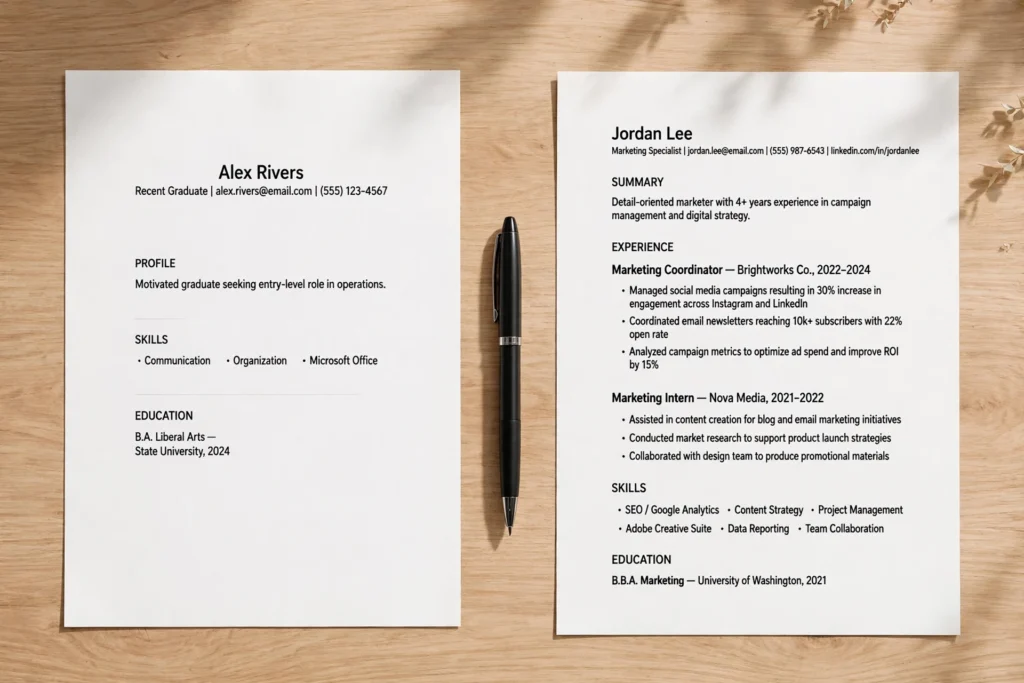
The Vague Version Jordan Started With
Work Experience
Sales Assistant, City Mart, 2025. Worked in a shop and helped customers. Responsible for stock and cleaning.
Marketing Intern, Brightline Media, 2026. Helped the marketing team with social media and other tasks. Gained experience in a professional environment.
Final Year Project, 2026. Built a system using Python for a clinic.
That version is honest, but it says almost nothing — which is the usual starting point before someone learns how to describe work experience freshers can write properly. There are no verbs with weight, no tools, no results, and no dates a reader can check. An employer reading it learns that Jordan worked somewhere, once, and that is all. The two versions below keep every fact and change only the wording — and the difference is the whole point of this guide.
Version One: Jordan Applies for a Junior Data Role
Work Experience
Sales Assistant (part-time), City Mart, June to August 2025. Recorded daily sales figures and stock counts in a spreadsheet at the end of each shift, and flagged items running low so the manager could reorder before they ran out. Checked delivery notes against the stock list and corrected three errors in the first month, so the records matched what was actually on the shelves. Served 30 to 40 customers per shift at the till using the point-of-sale system, handling cash and card payments with no end-of-day shortages over three months.
Marketing Intern, Brightline Media, June to July 2026. Collected weekly engagement numbers into a spreadsheet for the team meeting, so the team could see which posts worked and which did not. Drafted six social media posts a week in Canva and scheduled them in the team’s planner, following the brand guide for tone and images. Answered customer messages on the company inbox during the morning shift, and passed anything urgent to the supervisor the same day.
Final-year project: booking system for a local dental clinic, January to May 2026. Built the booking form and appointment list in Python with a simple database, so the clinic could take bookings without phone calls. Tested the system with the receptionist over two weeks and fixed the double-booking fault she found. Wrote a one-page user guide so the staff could use it without help.
Notice what the data version leads with in every entry: records, numbers, checking, and accuracy. That ordering is how to describe work experience freshers can aim at a data role without changing a single fact. The shop job leads with the spreadsheet, not the customers. The internship leads with the engagement numbers, not the posts. The project leads with the database, not the design. The same history, aimed at a reader who cares about data, and every bullet gives that reader something to check.
Version Two: Jordan Applies for a Customer Support Role
Work Experience
Sales Assistant (part-time), City Mart, June to August 2025. Served 30 to 40 customers per shift, answered product questions, and handled complaints calmly, including during the busy weekend rush. Trained a new starter on the till in her first week, showing her the routine and checking her first ten transactions. Restocked shelves each morning from the delivery list and checked expiry dates, so the shop opened on time every day.
Marketing Intern, Brightline Media, June to July 2026. Answered customer messages on the company inbox during the morning shift, and passed anything urgent to the supervisor the same day. Drafted six social media posts a week in Canva and scheduled them in the team’s planner, following the brand guide for tone and images. Collected weekly engagement numbers into a spreadsheet for the team meeting, so the team could see which posts worked.
Final-year project: booking system for a local dental clinic, January to May 2026. Tested the system with the receptionist over two weeks and fixed the double-booking fault she found, then wrote a one-page user guide so the staff could use it without help. Built the booking form and appointment list in Python with a simple database, so the clinic could take bookings without phone calls.
The support version leads with people in every entry: customers, a new starter, the receptionist, the clinic staff. The shop job leads with serving and handling complaints. The internship leads with answering messages. The project leads with testing with a real user and writing a guide for real staff. The facts are identical. The order is different, because the reader is different, and that is what tailoring a work experience section actually is: the same honest history, reordered and reworded for the job in front of you.
One more thing the two versions show: neither one invents anything. No percentages, no growth claims, no team sizes, no tools Jordan never touched. The difference between the vague version and either good version is not exaggeration. It is specificity — verbs, tasks, tools, and results, in the order the target job cares about. That habit of choosing specifics over adjectives is the heart of how to describe work experience freshers can be confident about, because every word can be backed up.
Tailoring the Section in Two Minutes per Application
Tailoring sounds like a big job, and for a fresher it is not — once you know how to describe work experience freshers already have, the tailoring is mostly reordering, not rewriting. You do not rewrite the whole resume for every application, and you do not need a new method for how to write work experience on resume entries each time — you need the same bullets, reordered. You make three small changes, and they take about two minutes once the section is written properly.
First, read the job ad and underline the three things it mentions most: the tools, the tasks, and the kind of person it describes. If the ad names a spreadsheet, a ticketing system, or a design tool, that tool should appear in your bullets if you have used it. If the ad talks about customers, the customer bullets go first. If it talks about accuracy and records, the records bullets go first. That is the whole reading step, and it takes less than a minute.
Second, reorder the bullets inside each entry so the most relevant one comes first, as the two Jordan Lee versions above show. Do not rewrite the bullets. Just move them. The bullet that matches the ad goes to the top of its entry, and the entry that matches the ad best gets an extra bullet if it has one to spare.
Third, check the first line of the section against the ad and change one word if you need to. If the ad calls the role “Customer Support Assistant” and your heading says “Work Experience”, nothing needs to change. If the ad asks for “experience with spreadsheets” and your first bullet mentions a spreadsheet, you are done. Tailoring is not rewriting. It is aiming, and aiming is mostly reordering.
If you are building the page from scratch, start from one of the free templates on ResumeForg and drop your finished experience section into it, rather than designing a layout first and writing the words second. The template handles the layout. Your job is the wording, and the wording is what this guide has been about.
Frequently Asked Questions
How do I describe work experience if I have only done one short job?
Describe that one job well, and let it carry the section — that is the short answer to how to describe work experience freshers can manage with a single entry. Give it a plain title with the dates, then three or four bullets through the formula: verb, task, tool, result. One job described properly, with real tasks and real numbers, is stronger than three jobs described vaguely.
If the job was very short, name the length honestly — seasonal, a summer, a few weeks — and say what the short stay proves, such as learning a system quickly or keeping a schedule. Do not pad the section with courses or hobbies to make it look longer. The reader can tell, and a short, honest section earns more trust than a long, padded one.
Should I include a job that has nothing to do with the role I want?
Yes, if it proves something the employer cares about. An unrelated job proves you can keep a schedule, handle people, work under pressure, and finish what you start, and those are the things an employer worries about most with a fresher. Translate it by naming the transferable part instead of the title, as the unrelated-job section above shows, and keep it to two or three bullets. Leave it off only if it was a few days long with nothing of substance to describe, or if the page is already full with more relevant entries.
Can I put volunteer work under Work Experience?
Only if it is clearly labelled as volunteer work, and usually it is better under its own heading. Mixing paid and unpaid entries without labels confuses the reader about what was employment and what was not. Give volunteer roles their own heading, or mark them clearly with the word volunteer in the title, and write them with the same formula — verb, task, tool, result — because the wording method does not change. The guide to volunteer and part-time work on a fresher resume shows how to draw the line between the two kinds of entry.
What if I have no numbers to put in my bullets?
Then do not invent any. A bullet without a number is still a good bullet if the verb, task, and tool are specific. Describe what would have been different if the work had been done badly: customers would have waited longer, shelves would not have been stocked before opening, messages would have gone unanswered. That is a result, and it is honest. Small, real numbers are better than large, invented ones, and no number at all is better than a number you cannot explain in an interview.
How long should the work experience section be on a fresher resume?
Short. On a one-page resume, the whole section should take about a third of the page at most. Each entry gets two to four bullets, the most relevant entry gets the most, and the whole section stays under roughly 250 words. If your entries are running long, you are probably describing duties instead of results — cut the duty and keep the result. The rest of the page needs room for education, projects, and skills, and a work section that takes half the page is a work section that has crowded everything else out.
Is it okay to leave the Work Experience heading out completely?
Yes, if you have no paid work to put under it. Leave the heading out and let education, projects, and volunteering carry the page under their own headings. Add a work section later, when there is real work to put in it. An absent heading is not a weakness. A heading with nothing honest under it is, and it is also the first thing a careful reader notices.
A Short Checklist Before You Send It
Before the resume goes out, run through this list once. Every entry has a plain title, an employer or client type, and exact dates. Every bullet has a verb, a task, a tool, and a result. Every number is one you could explain in a sentence. No title is inflated, no date is stretched, no result is borrowed, and no tool is listed that you never used.
The most relevant entry has the most bullets, and the most relevant bullet in each entry comes first. Volunteer work is separated from paid work. The heading matches how much real work there is — Work Experience, Experience, or no heading at all. Running through it is the last step in how to describe work experience freshers present honestly: plainly, with proof, and without padding.
If every item on that list is true, the section is ready, and the rest is repetition: read the ad, reorder the bullets, send it, and move on to the next one. That is the whole of how to describe work experience freshers can keep using, application after application. Describing work experience when you have little of it is not about having more to say. It is about knowing how to describe work experience freshers already have clearly enough that a stranger can see it, trust it, and picture you doing it again for them. That is the whole skill, and it is one you can practise on every application from here on.
1 thought on “How to Describe Work Experience on a Fresher Resume: Complete Guide 2026”