
Sending the same resume to every job feels efficient, but it is usually the reason a fresher hears nothing back. Recruiters do not read a resume looking for a good person in general. They read it looking for a good fit for one specific role, and they decide in seconds whether that fit is obvious. Learning how to tailor your resume for each job does not mean rewriting your whole history every time you apply. It means starting from one strong master resume, then making a short, honest, targeted copy for each role — one that puts the employer’s priorities first and leaves out everything that distracts from them.
This guide explains how to tailor resume for each job step by step.
This guide shows you that process step by step. You will learn how to read a job description the way a recruiter does, how to pick keywords without lying or stuffing them in, how to rewrite your summary and bullets for one role at a time, and how to keep every version organised so applying stays fast. The examples follow one fictional fresher, Jordan Lee, and the same university project rewritten for two different jobs, so you can see exactly what changes — and what stays the same.
Table of Contents
Why One Generic Resume Loses Out, Even for Freshers
A generic resume tries to speak to everyone, so it ends up speaking clearly to no one. When a job asks for customer support skills and your resume leads with data entry, spreadsheets, and a long list of unrelated coursework, the recruiter has to hunt for the match. Most will not hunt. They will move on to the next application, where the match is visible in the first few lines.
Tailoring is not about inventing experience. It is about order and emphasis. Two freshers can have the same project, the same part-time job, and the same degree, and one will look like a natural fit while the other looks unfocused — simply because the first one put the relevant proof first, used the employer’s own words for real skills, and cut the rest. That is the whole advantage, and it is fully available to someone with no full-time experience yet.
There is a second, quieter reason tailoring matters. Many employers use applicant tracking systems, software that reads and ranks resumes before a human sees them. A tailored resume that naturally uses the role’s key terms is easier for both the software and the human to understand. A generic resume, even a strong one, can be misread or ranked lower simply because its most relevant words are buried or missing.
Build Your Master Resume First
Before you tailor anything, build one complete master resume. This is your private, longer document. It holds every project, part-time job, volunteer role, course, tool, and achievement you might ever want to mention. It can run to two pages. Nobody sends the master resume itself. Its job is to make tailoring fast: for each application, you copy it, then delete, reorder, and rewrite — never start from a blank page.
A good master resume for a fresher usually contains a short general summary, a full skills list, education, two or three projects with several bullets each, any work or volunteer experience, and certifications or relevant courses. Write each bullet with a result where you can, even a small one: how many people you helped, how much time you saved, or what improved. When you later tailor for a specific job, you will pick the strongest two or three bullets for that role and leave the rest in the master file, ready for a different role.
If you do not have a master resume yet, start there before applying to anything else. ResumeForg’s step-by-step guide to writing a resume walks through each section in order — and it pairs well with this guide: build once, then tailor many times. Keep the master resume updated every time you finish a project, a course, or a part-time role, so it stays a true record rather than something you have to rebuild from memory.
Read a Job Description Like a Recruiter: Must-Have vs Nice-to-Have
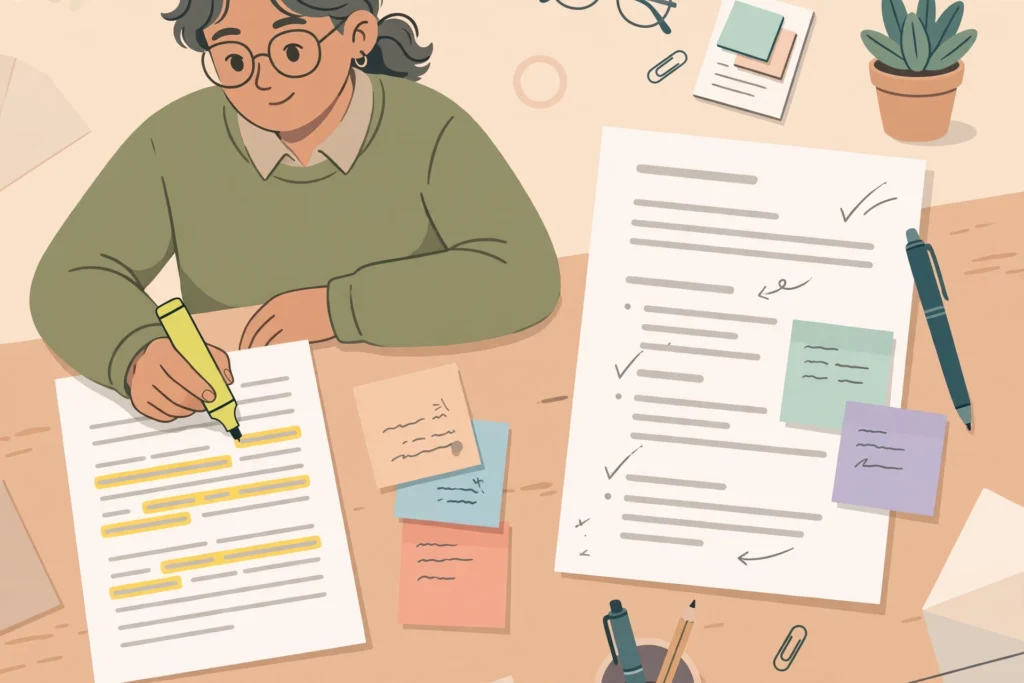
The job description is your brief, not a list of words to copy. Read it twice. On the first read, look for the overall story: what problem will this person solve, and what kind of day-to-day work will they actually do? On the second read, mark two groups. Must-haves are the requirements listed as required, essential, or non-negotiable — the skills and qualifications the employer will screen for first. Nice-to-haves are the preferred, bonus, or “would be great” items. They strengthen an application, but they do not replace a missing must-have.
Pay attention to repetition. If a posting mentions clear written communication three times, in the summary, the responsibilities, and the requirements, that is a priority, not a coincidence. Note the exact words the employer uses for tools, tasks, and qualities, and note the verbs: support, organise, analyse, respond, and coordinate each describe a different kind of work. A customer support role that stresses patience, clear writing, and resolving queries is asking for different proof than an administrative role that stresses accuracy, records, and deadlines — even if both roles would suit the same fresher.
Finally, read what the posting does not say. A short posting that lists only a handful of requirements is telling you to keep your resume focused on those few things. A long posting with twenty requirements is not asking you to claim all twenty. It is asking you to show your strongest matches clearly and honestly, and to leave the rest alone.
Pick Keywords Honestly — and Where They Belong
Keywords are simply the words an employer uses for the skills, tools, and tasks that matter for the role. When you tailor a resume, you are choosing which of your real skills to name, in the employer’s language, and where to place them so they are easy to find. The honest rule is simple: use a keyword only if you can back it up with a project, a course, a job, or a concrete example. If you cannot explain it in an interview, it does not belong on your resume.
Place keywords where they naturally belong. The summary should carry the two or three most important ones for the role. The skills section should list them plainly, without dressing them up. Experience and project bullets should show them in action — not as a list of terms, but inside a sentence about what you did and what happened as a result. That is the difference between matching a job description and stuffing it: one reads like proof, the other reads like a word list.
A useful check is to read your tailored resume aloud. If a sentence exists only to hold a keyword, rewrite it or cut it. If removing a keyword would make the bullet less true, keep it. Monster’s guide to writing a targeted resume walks through the same idea in practical steps, from analysing the posting to customising the summary and weaving keywords naturally into real accomplishments rather than stuffing them in.
University career guides make the same point in different words: the University of Maryland Global Campus guide on personalising a resume for different roles advises starting from one master version and adjusting keywords, skills, and bullets to relate directly to the specific job description, rather than building a new resume from scratch each time. That master-first approach is exactly what this guide recommends, and it keeps honest tailoring fast.
That habit, one master resume adjusted honestly for each posting, is how to tailor resume for each job without starting from scratch.
Rewrite the Summary for That One Role
Your summary is the first thing a recruiter reads, so it is the first thing you tailor. A generic summary — “Motivated graduate seeking an opportunity to grow and contribute” — could belong to anyone, for any job. A tailored summary names the role, the two strongest matching strengths, and one piece of proof, in two or three lines. It should be impossible to paste it onto a different application without it sounding wrong.
Compare the two. Generic: “Recent graduate with strong communication and organisational skills, looking for a challenging role.” Tailored for a customer support role: “Recent graduate with experience handling customer queries, writing clear support replies, and resolving routine issues during a part-time campus help-desk role. Looking to bring calm, accurate written communication to a customer support team.” Nothing in the tailored version is invented. It simply chooses the relevant experience, names it plainly, and points it at one job.
If you are still shaping how a summary should read, ResumeForg’s guide to writing a resume summary explains the structure in more detail. Use it for the general craft, then come back here for the tailoring step: for each job, rewrite the summary last, after you have chosen your keywords and bullets, so it honestly reflects what the rest of that version actually shows.
Reorder Skills and Projects, Cut What Does Not Help This Role
Tailoring is mostly subtraction and reordering, not addition. Open your master resume, copy it, and then ask of every section: does this help this employer see me in this role? If the answer is no, cut it from this version. It stays safe in your master file for another application. If the answer is yes, move it higher. Recruiters scan from the top, so the most relevant skill, project, or bullet should never sit at the bottom of the page.
Skills are the easiest section to tailor. For a support role, lead with written communication, problem-solving, and any help-desk or ticketing tool you have genuinely used. For an administrative or data-entry role, lead with accuracy, spreadsheets, record-keeping, and attention to detail. Same person, same skills, different order — and a very different first impression. ResumeForg’s guide to skills to put on a resume can help you phrase each skill cleanly — but the tailoring decision itself is yours: order follows the job description, not your personal favourites.
Projects work the same way. A fresher with three projects does not need to show all three in full for every job. Show the one project that matches best, with two or three strong bullets, and mention the others briefly or leave them out for this version. Cutting is not hiding experience. It is respecting the reader’s time and making your best match unmissable.
Before-and-After Examples: Jordan Lee, Two Roles
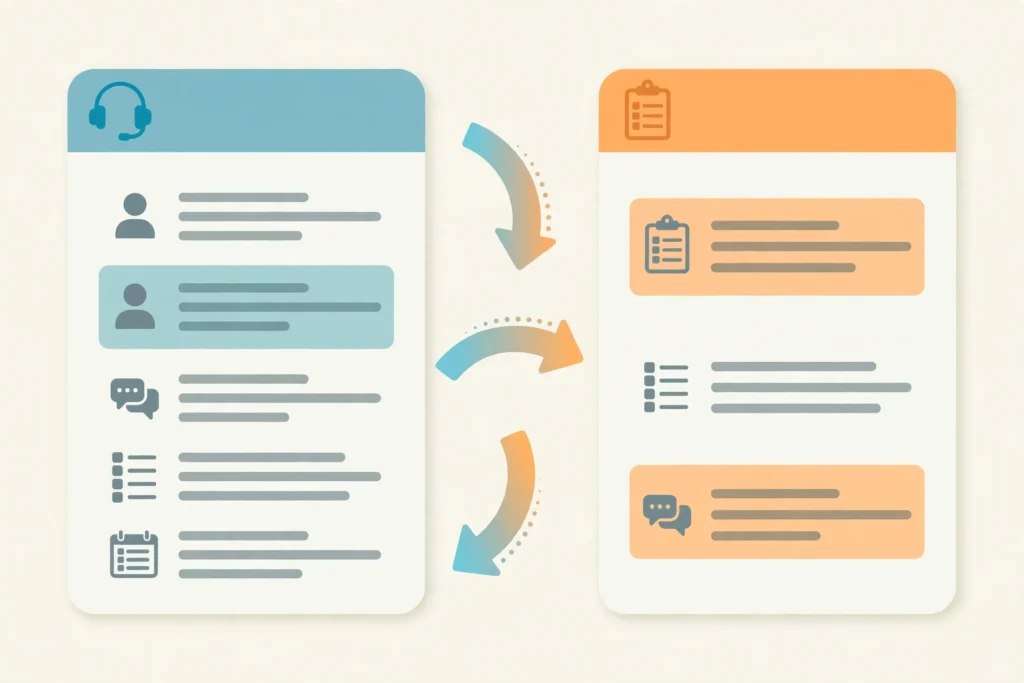
Here is the same experience, tailored two ways. Jordan Lee is a recent graduate who ran a student society help desk, organised event registrations in a spreadsheet, and completed a short data-handling course. The raw material is identical. Only the emphasis changes.
For a customer support role, the original generic bullet — “Helped with student society activities and handled spreadsheets” — becomes: “Answered around 30 student queries a week by email and in person at the society help desk, writing clear replies and resolving routine account and event questions, with follow-up for anything unresolved.” The support version leads with communication, volume, and resolution, because that is what the role rewards.
For a data-entry and administrative role, the same experience becomes: “Maintained the society’s registration records for 200 members in a spreadsheet, checking entries for errors, updating contact details, and producing a weekly summary for the organising team.” The administrative version leads with accuracy, records, and reporting, because that is what that role rewards. Neither version invents a tool or a result. Each one simply selects the true details that matter for that job and writes them in that job’s language.
Try this exercise with your own experience. Take one project, write one generic bullet, then rewrite it twice — once for each of two roles you are actually targeting. If the two rewrites look identical, you have not tailored yet. If each one would sound odd sent to the other role, you have.
Keep It One Page and ATS-Readable
For most freshers, one page is the right length for a tailored resume. Tailoring should make your resume shorter, not longer, because cutting irrelevant material is part of the process. If your tailored version spills onto a second page, that is a signal to cut more, not to shrink the font or squeeze the margins. One page also forces the discipline this guide is built on: only the strongest, most relevant proof makes the cut.
Keep the format simple and readable for both humans and screening software. Use standard headings such as Summary, Skills, Education, Projects, and Experience, one clean font, and consistent spacing. Avoid tables, text boxes, graphics, and unusual symbols in the body of the resume, since those can confuse automated readers. For a full checklist of headings, layout, and formatting choices that stay readable, see ResumeForg’s ATS resume format guide.
A final formatting rule for tailoring: do not change your layout for every job. Changing fonts, colours, or section order each time makes versions harder to compare and easier to break. Tailor the words, keep the design steady. Your reader should recognise the same professional document, pointed at a different role.
Save, Name, and Track Each Version
A tailored resume you cannot find again is wasted work. Save each version as its own file, with a name that tells you exactly what it is: your name, the role, and the company, for example Jordan-Lee-Support-Role-Resume.pdf. Save it as a PDF unless the posting asks for another format, since a PDF preserves your layout on any device. Keep the master resume separate, clearly labelled as the master, so you never accidentally send the long version.
Track your applications in a simple list or spreadsheet: company, role, date sent, version file name, and any follow-up date. This does three useful things. It stops you sending the wrong version to the wrong employer, it lets you reuse a strong tailored version as the starting point for a similar role, and it shows you, over time, which kinds of roles are getting replies and which are not. If one tailored version is getting interviews and another is not, that pattern is worth noticing — it may tell you more about fit than about formatting.
Common Tailoring Mistakes to Avoid
The most common mistake is overstuffing: pasting every keyword from the posting into every section until the resume reads like a word list. Recruiters notice, and so do automated readers in the worst way — a stuffed resume looks less credible, not more qualified. A second mistake is the opposite: changing so little that only the company name differs. If your summary, skills order, and top bullets are identical across five applications, you have not tailored, you have renamed.
Other mistakes are quieter but just as costly. Claiming a tool or language you have not used is not tailoring; it is misrepresentation, and it falls apart in an interview. Copying sentences from the job description into your resume reads as filler, not proof. And sending a tailored resume with a generic cover letter — or no cover letter where one is expected — wastes the work you just did. Your cover letter should point at the same role, in the same terms. ResumeForg’s cover letter guide for freshers shows how to do that without repeating your resume word for word — and it is a natural companion to this guide when a posting asks for both documents.
Finally, do not tailor by guessing what an employer wants instead of reading what they wrote. If a posting never mentions a skill, adding it prominently will not help, however proud you are of it. Tailoring means listening first, then choosing.
Quick Checklist Before You Send
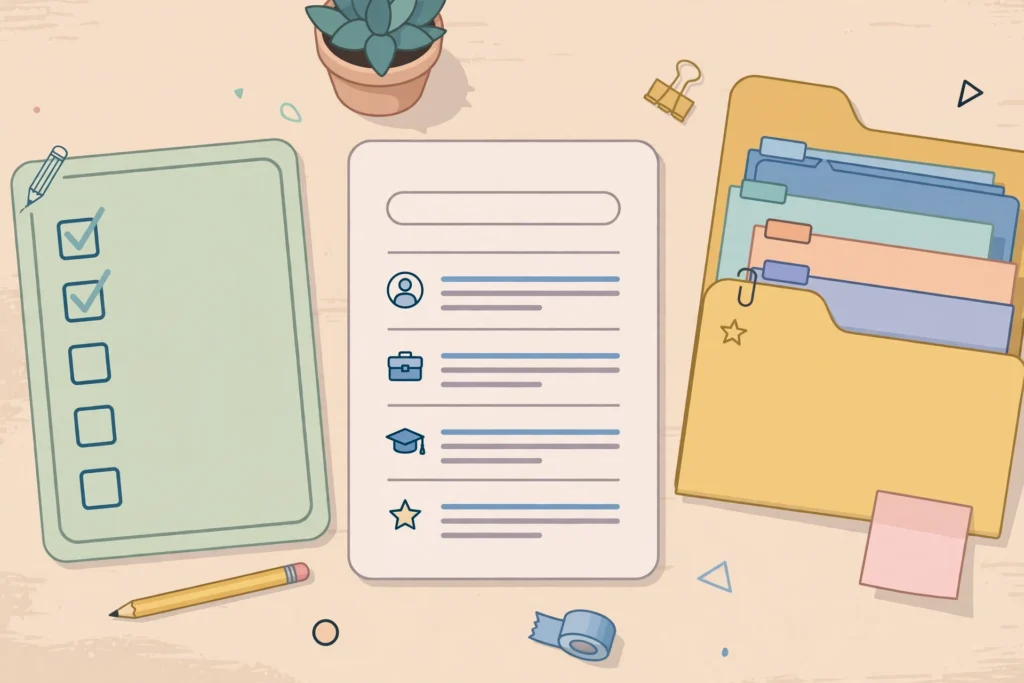
Run through this list for every tailored version, every time. It takes five minutes and catches most errors.
First, read the summary: does it name this role and its two most important requirements? Second, scan the skills section: are the job’s must-have skills visible near the top, and is every skill one you can genuinely defend? Third, check your top three bullets: do they show results, in the employer’s language, for this role specifically? Fourth, confirm the file name and format: your name, the role, and PDF unless asked otherwise. Fifth, proofread the whole page slowly, out loud if you can, checking names, dates, and spelling — and check that you have not left a previous employer’s name or role title in from an earlier version. That last error is the classic tailoring slip, and it is entirely avoidable with one careful read.
If any item fails, fix it before sending. A tailored resume sent a day later, correct, is worth far more than a rushed version sent with the wrong role title in the summary.
Frequently Asked Questions About How to Tailor Resume for Each Job
How long should tailoring take for each job? Once your master resume exists, most freshers can tailor a version in fifteen to thirty minutes: read the posting, pick the keywords, rewrite the summary, reorder skills and bullets, cut the rest, and proofread. If it regularly takes over an hour, your master resume probably needs more complete bullets to choose from, or you are rewriting sections that only needed reordering.
Should I tailor my resume for every single job? Yes, in the light sense this guide describes: a copied master version, a rewritten summary, reordered skills, and cut or reordered bullets. That is tailoring. You do not need a brand-new resume for every job, and you should not write one. The Concordia University, St. Paul career guide on tailoring without starting from scratch makes the same case: build a strong base for each type of role you target, then make focused adjustments for each individual posting, and save each version so a similar role later starts from an even stronger base.
What if I do not meet every requirement in the posting? Apply if you meet the core must-haves and can show genuine, related proof for most of them. Nobody sensible expects a fresher to tick every box. Tailor around your real strengths, name related experience honestly — a university project can be real proof of a skill — and do not claim the rest. Employers often treat postings as wish lists, and a clear, honest, well-tailored resume stands out against a long, vague one.
Should my cover letter be tailored too? Yes. A tailored resume with a generic cover letter sends a mixed message. Keep the cover letter short, name the role, and explain in two or three sentences why your strongest proof fits this job. The two documents should agree with each other, not repeat each other.
How many versions of my resume should I keep? Keep one master resume, plus one saved, clearly named version per application. Over time you will also build a few strong base versions for the main types of roles you target — for example, one leaning toward support work and one leaning toward administrative work. That small library is what makes future tailoring fast, and it is far more useful than a folder of near-identical files with vague names.
Final Word: Tailor Less, But Tailor Every Time
Tailoring a resume is not a trick, and it is not a rewrite. It is a habit: one master resume, one careful read of the job description, a few honest changes in the right places, and a clean, well-named file sent on time. Done that way, it costs less than half an hour per job, and it turns a generic application into one that reads as if it were written for exactly the role in front of you — because it was.
Start today with one real posting. Copy your master resume, work through the checklist above, and send a version that leads with what that employer actually asked for. Then do it again for the next role. That steady, honest repetition is what makes a fresher’s applications stand out, one tailored resume at a time. And if you are still building the foundation underneath all of this, go back to the beginning: a strong master resume, a clean one-page format, and — if you have made the same errors most freshers make — a quick read of ResumeForg’s guide to resume mistakes for freshers, which covers the pitfalls to clear before you tailor anything at all.
The habit is simple: learn how to tailor resume for each job once, then repeat the same short process for every role.
3 thoughts on “How to Tailor Your Resume for Each Job: Freshers Guide 2026”