
Most freshers reach the bottom of their resume and stop. The education is written, the skills are listed, the projects are in place, and there is one line of space left. That is when the question arrives, and it arrives with a surprising amount of anxiety for such a small decision: should freshers include references on resume pages, or is that a leftover from another era of job hunting? The temptation is to fill the space.
A line that says “References available on request” looks finished. A list of two or three names with phone numbers looks thorough. Both feel like the safe choice, because leaving a space empty feels like leaving something out. Ask “should freshers include references on resume?” and the honest answer is that the space is not the problem. The problem is spending it on something the reader does not need yet, while the things they do need are still squeezed into the lines above.
This guide answers the question — should freshers include references on resume? — with a plain decision instead of a template. It covers when references belong on the page and when they do not, why the phrase “References available on request” wastes a line, who counts as a suitable referee for a student, who does not count, how to ask permission, and how to prepare a referee so they are ready when the employer calls. It also shows how to build a separate reference sheet, and what to do if you do not have any referees yet.
The examples use one fictional student, Jordan Lee, a final-year business student applying for an entry-level customer service role, so you can see the same resume with the space used well and the same resume with it wasted. Nothing in this guide asks you to publish anyone’s private contact details on your resume, and nothing in it asks you to invent a referee you do not have.
Table of Contents
The short answer to should freshers include references on resume
The short answer to whether freshers should include references on resume pages is usually no — not on the resume itself. Keep references off the page, keep them ready separately, and send them only when the employer asks. That is the rule behind the answer to “should freshers include references on resume?”, and it covers most applications, most employers, and most entry-level roles. It is not a guess, and it is not a fashion. It follows from how hiring actually works. A recruiter reads a resume to decide whether to interview you.
They do not check references at that stage. Nobody calls a tutor or a former supervisor before deciding whether a candidate is worth a conversation, because there are too many applicants and too little time. References are checked near the end of the process, when the employer is choosing between a small number of candidates and wants to confirm what they already believe. Putting them on the first page answers a question nobody is asking yet, and it spends the most valuable thing on a one-page resume — space — on information the reader will skip.
There is a second reason the answer to “should freshers include references on resume?” is usually no, and it is about privacy. A resume is a document that gets sent to dozens of employers, uploaded to job boards, and forwarded between people you will never meet. Every name, phone number, and email address printed on it travels with it. Your own contact details have to be there; that is the point of the document. Someone else’s do not. A tutor’s phone number or a supervisor’s personal email address is not yours to distribute to every company you apply to, and printing it on a resume means you have no control over where it ends up.
A separate reference sheet, sent only to an employer who has asked for it, keeps that information in the right hands at the right time. It is a small courtesy that says something good about your judgement, and it is one of the reasons the question of whether freshers should include references on resume pages has a different answer from the question of whether freshers should have references ready. You should have them ready. You should not print them.
That said, the short answer has exceptions, and this guide is about the exceptions as much as the rule. The question — should freshers include references on resume? — is a decision, not a reflex, and the rest of this guide walks through it. Sometimes the job posting asks for references with the application. Sometimes the employer is a small business that checks references early.
Sometimes you are applying for a role where trust matters more than usual — working with children, handling money, or entering someone’s home — and a reference up front is part of how you are judged. In those cases, the right answer is different. The rule is “usually no.” The work is knowing when “usually” does not apply.
The decision rule: when should freshers include references on resume
The decision — should freshers include references on resume? — comes down to one question: did the employer ask for them? If the job posting, the application form, or the recruiter’s email says “please include references” or “references required with application,” then include them. Following the employer’s instructions matters more than any general rule about resume writing, and an application that ignores a direct instruction is an application that looks careless.
This is the one case where the answer is a clear yes. If they asked, give them what they asked for, in the format they asked for. If they asked for references on the resume itself, put a short references section on the resume. If they asked for references with the application, a separate sheet attached to the same email is usually the better choice — more on that below.
If nobody asked, the answer to “should freshers include references on resume?” is no, and the reason is space. A fresher resume is usually one page, and every line on that page has to earn its place by telling the reader something they need to decide about you. A reference’s name and phone number tells them nothing about your skills, your experience, or your fit for the job. It tells them about someone else.
The same space, used for a project bullet, a skill with proof, or a part-time job entry, tells them something they can act on. That is the trade-off at the heart of the question “should freshers include references on resume?”: every line spent on references is a line not spent on you. When you have three years of work experience and a two-page resume, the trade-off is smaller. When you are a fresher with one page and no job history, it is the whole game.
Should freshers include references on resume when the employer is a small business that checks references early? Sometimes — and the two narrower exceptions below cover those cases. There are two narrower exceptions worth knowing about. The first is a role where references are part of the assessment from the start. Some employers — a school hiring a teaching assistant, a care provider, a security firm — treat a reference as part of the application rather than a later check, because the role involves trust and they want to know early who can speak for you.
If the posting hints at that, or if the field is one where references are routinely requested up front, including them is a reasonable judgement call. The second exception is a referral. If someone the employer knows has offered to be your reference and you are applying partly on the strength of that connection, naming them can help — but even then, a short line such as “Reference: Dr. Amara Chen, Senior Lecturer, Business School” with no contact details, or a mention in your cover letter, usually does the job better than a full contact block on the resume. The employer can ask for the details when they want them, and the name alone carries the signal.
A simple way to answer “should freshers include references on resume?” every time is to run through three questions in order. First, did the posting ask for references? If yes, include them. Second, does the role involve a level of trust where references are checked early? If yes, consider including them. Third, is there anything else on the page that still needs the space? If yes — and for a fresher, there almost always is — leave references off, keep the sheet ready, and use the space for evidence about you.
That is the whole decision rule for the question “should freshers include references on resume?”. It takes thirty seconds to apply, and it stops the question from eating an evening.
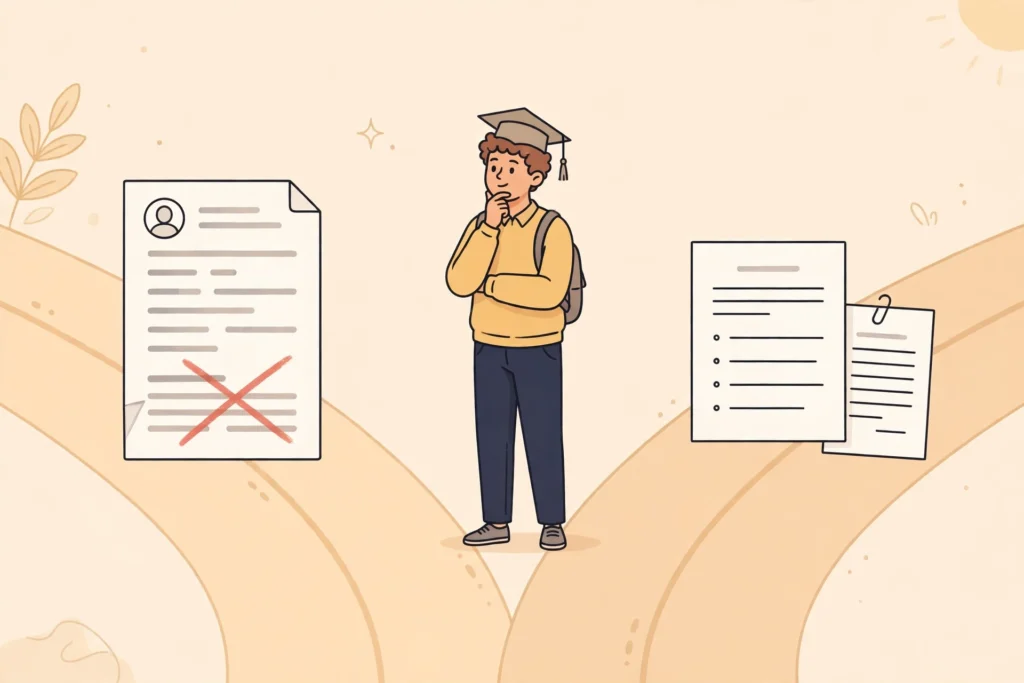
“References available on request” — why it wastes a line
The phrase “References available on request” is the most common answer to the question “should freshers include references on resume?”, and it is the worst one. It looks like a compromise — not listing anyone, but signalling that you can — and it is a compromise that gives the reader nothing. Employers already know they can ask for references. They do not need to be told. The line states something obvious, takes up a line of space, and tells the reader nothing about you. It is the resume equivalent of writing “I am available for interview” — true, assumed, and a waste of the line.
The phrase is also a marker. It comes from a time when resumes were longer, references were routinely printed, and the phrase was a polite way of saying the list was available. It is a sign that the writer never really answered the question “should freshers include references on resume?” — they copied a template instead. Today it reads as dated, and a recruiter who sees it will quietly file the resume under “written from an old template” — not a fatal judgement, but not a helpful one either, and entirely avoidable.
When you are asking “should freshers include references on resume?”, the phrase is not a middle ground between listing them and leaving them off. It is the worst of both: it spends the space without providing the information, and it signals that the writer was following a template instead of making a decision.
So when the answer to “should freshers include references on resume?” is no, what do you write instead? Nothing. Leave the line off entirely. The resume ends with your last real section — skills, projects, or education — and the page is finished. If the employer wants references, they will ask, and you will have the sheet ready. That silence is not an omission. It is the modern convention, and every recruiter reading your application already understands it. The space you save is real: one line is enough for a skill, a project result, or a part-time job bullet, and any of those is worth more than a phrase that states the obvious.
There is one place where a version of the phrase still has a use, and it is not on the resume. In a cover letter or an application email, a short closing line such as “I am happy to provide references on request” can work, because the letter is a conversation and the line is a natural closing gesture rather than a wasted line on a one-page document.
Even there, it is optional. Our guide to how to tailor your resume for each job explains the same principle in a different form: every line has to be written for this reader and this role, and a line that could sit on any application belongs on none of them. If you are short of space on the resume, the phrase is the first thing to cut, before anything that says something real about you.
Who counts as a referee for a fresher
If the answer to the question “should freshers include references on resume?” is “not on the page, but ready separately,” the next question is who those references should be. For a fresher, the honest answer is that your referees will look different from an experienced hire’s, and that is fine.
Nobody expects a final-year student to produce three former managers. Employers hiring freshers know the candidates have limited work history, and they judge referees on whether the person can speak about your work, your reliability, and your character from direct experience — not on how senior the person is. A tutor who supervised your final project for six months is a better referee than a company director you met once at a careers fair. The test is always the same: has this person seen you work, and can they talk about it specifically?
The strongest referees for a fresher, in rough order, are these. First, a tutor or lecturer who supervised a project, a dissertation, or a substantial piece of coursework. They can speak about your thinking, your writing, your deadlines, and how you handled feedback — all things an employer cares about. Second, an internship or part-time work supervisor. Even a short internship gives a supervisor something real to say: did you turn up, did you learn quickly, did you handle the work?
Third, a volunteer coordinator or a society lead. If you ran events, managed a budget, or coordinated volunteers, the person who oversaw that work can speak about your reliability and your initiative. Our guide to volunteer and part-time work on a fresher resume shows how to write those roles as proper entries, and the same people who supervised them are often your best referees precisely because they saw you work over months, not in a single exam. Fourth, a placement or careers adviser who knows your work well, though this is weaker than the first three because the relationship is usually less direct.
Two or three referees are enough. Three is the usual number employers expect, and for a fresher, two strong referees are better than three where the third is weak. Two or three are all the list needs to be when the answer to “should freshers include references on resume?” is yes. When the answer to “should freshers include references on resume?” is yes, order them by relevance to the role, not by seniority: the person who can speak most directly about the skills the job needs goes first. A tutor who supervised a project in the same field as the job belongs at the top.
A supervisor from an unrelated part-time job, however kind, belongs lower down, because what they can say is less directly useful. And the reference sheet should say, in one short phrase, what each person’s relationship to you is — “Final-year project supervisor,” “Internship supervisor,” “Volunteer coordinator” — so the employer knows immediately why this person’s opinion counts.
A university careers guide makes the same point from the employer’s side: the best referees are supervisors, volunteer coordinators, and professors — people who have seen your work, not people who happen to hold an impressive title. The University of Iowa’s careers team puts it plainly in their guide to who to ask for a reference, which lists the same kinds of people and explains what each one can speak about.
Who does not count as a referee
Knowing who does not count as a referee is as important as knowing who does, and it is where freshers make the most avoidable mistakes. When the answer to “should freshers include references on resume?” is yes for one application, the names on the list matter more than the number of them. The rule is simple: a referee has to be someone who has seen you work, study, or take responsibility — and who is not related to you and not a close friend. Family members are out, however senior or well-connected they are.
A parent, a sibling, an uncle, or a family friend cannot be a referee, because their opinion is not independent and the employer knows it. Listing a relative as a referee does not add credibility; it takes it away, because it suggests you could not find anyone else. Close friends are out for the same reason. A friend can say you are a good person, but they cannot speak about your work, and an employer who calls them will hear exactly that.
There are a few other people who look like referees but are not. A lecturer who taught a large class you attended but never spoke to you is not a referee, because they cannot say anything specific about you — and a vague reference is worse than no reference, because it tells the employer that nobody who knows your work was willing to speak for you.
A manager from a job you left on bad terms, or after a very short time, is a poor choice, even if the title looks good. And a peer from a group project is a weak referee, because the employer wants someone who supervised or assessed you, not someone at your own level. If you are tempted to list someone because their title sounds impressive, ask the test question: if the employer called this person and asked “tell me about Jordan’s work,” could they answer for two minutes with specific examples? If not, they are not a referee, however good the title looks on paper.
There is also a practical question that comes up often: can you use a referee from another country, or someone whose English is not their first language? Yes, in both cases, as long as they can be reached by phone or email and can speak about your work. A global job search means global referees, and an employer hiring freshers is used to it. What matters is that the person is reachable and relevant, not where they are based. Just make sure the contact details on your reference sheet are current, and that you have warned the person that a call or email may come from an employer in another country.
How to ask permission before you list anyone
The single most important rule in the whole question — should freshers include references on resume? — is this: never list someone as a referee without asking them first. It sounds obvious, and it is the rule freshers break most often, usually because they are in a hurry. A referee who is surprised by a call from an employer is a referee who gives a bad reference — not because they think badly of you, but because they were not ready, they could not remember the details, and they said something vague instead of something specific. Asking permission is not just polite. It is what makes the reference work.
Ask in person if you can, and by email if you cannot. Either way, the ask is what turns the question “should freshers include references on resume?” from a worry into a plan. In person is better, because it is a real conversation: you can explain the role, remind them of the work you did together, and hear whether they are willing. An email is fine too, and it has one advantage — it leaves a record, and the person can answer when they have time. Either way, the ask should contain four things: what you are applying for, what you did that they saw, what you would like them to say, and when they might hear from an employer.
A short version sounds like this: “I am applying for an entry-level customer service role, and I wondered if you would be willing to act as a reference. You supervised my final-year project on customer feedback, and I thought you could speak about the research and the presentation. I have applied this week, so they might contact you in the next few weeks. I can send you my resume and the job description if that helps.” That is the whole ask. It is respectful, it is specific, and it gives the person everything they need to say yes.
There are two things to avoid in the ask. The first is asking at the last minute. If you email a tutor on the day the employer asks for references, you are asking them to drop everything and prepare, and you are telling them you did not plan ahead. Ask when you start applying, not when you are asked for the list. The second is asking too many people, or asking people you barely know, in the hope that one of them says yes.
Three good asks are better than six hopeful ones, and a person who says no is doing you a favour — a reluctant referee is a weak referee, and it is better to know that before the employer calls than after.
If someone says no, thank them and move on. Do not argue, and do not ask again. A no is useful information when you are working out the answer to “should freshers include references on resume?” for a real application. If someone says yes, tell them straight away what happens next: you will send them your resume and the job description, you will let them know when you have applied, and you will tell them when you hear back. That is the beginning of preparing a referee, which is the next section. And if you are writing the email to ask, remember that the email itself is part of the impression you make.
Our guide to courses and certifications on a resume for freshers covers the same habit of keeping records current and honest, and the same applies here: a short, professional email with a clear subject line, your full name, and a polite close is worth more than a long, rambling one. The keyword-file phrase professional email for sending resume fits here in its natural place — the email you send to a referee is one of the first professional emails many freshers write, and getting it right matters.
How to prepare a referee so they can help you
A referee who has agreed to help you still needs help themselves. Preparing a referee is the step that decides whether the answer to “should freshers include references on resume?” actually helps you when the employer calls. That is the part most freshers skip. They ask, they get a yes, and then they assume the job is done. It is not.
A referee who last worked with you six months ago will not remember the details of your project, the dates, or the result. A referee who has never seen the job description will not know which of your qualities to emphasise. And a referee who does not know you have applied yet will be surprised when the call comes. Preparing a referee is not a chore. It is the difference between a reference that says “Jordan was a good student” and one that says “Jordan ran a customer feedback survey of 120 students, presented the findings to the department, and the department changed its welcome programme as a result.”
There are four things to send or tell a referee, and they are what make the answer to “should freshers include references on resume?” work in practice. None of them takes long. First, your current resume, so they can see what the employer is seeing and so their account matches yours. If your resume says you managed a survey of 120 students and the referee remembers 80, the mismatch is a problem you can fix in advance. Second, the job description, or at least the role title and the employer’s name, so they know what the job is and which of your qualities matter most.
Third, a short reminder of the work you did together — the project, the dates, the result — written as a few lines, not a lecture. Tutors supervise many students; a short reminder helps them place you. Fourth, a heads-up when you apply, and another when you reach the reference stage, so they are not caught off guard. A short email — “I have applied for the customer service role at Northgate Retail, and they may contact you in the next two weeks” — takes a minute and changes the quality of the reference completely.
Thank the referee afterwards, whatever the outcome. It is the last step in making the answer to “should freshers include references on resume?” work well in practice. A short email after the process ends — “Thank you for being a reference; I have accepted the role” or “Thank you for being a reference; I did not get this one, but I appreciate your help” — costs nothing and keeps the relationship in good shape for the next application.
Referees are people who are doing you a favour, and they remember who thanked them. The University of Toronto’s careers team covers the same steps in their guide to how to ask for and prepare a reference, which explains how to ask, what to give a referee, and why three or four referees is the right number for a recent graduate.
One more point, because it is easy to forget: keep your referees’ details current. A phone number from a year ago, an email address a tutor no longer uses, or a job title that has changed will all cause a delay, and a delay at the reference stage can cost you the offer. Check the details each time you send the sheet, and ask the referee if anything has changed. It takes a minute, and it is the kind of detail that separates a careful applicant from a careless one.
The separate reference sheet: what it looks like
The separate reference sheet is the practical answer to the question “should freshers include references on resume?”. It is a one-page document, separate from the resume, with the same heading as your resume — the same name, the same contact details, the same font — and three or four referees listed in order of relevance. Each referee gets four or five lines: full name, job title, organisation, the relationship to you, and contact details. That is all. No paragraphs, no testimonials, no extra information.
The sheet is a document the employer can use, not a document that tries to persuade. It is also the reason the question “should freshers include references on resume?” has a practical answer rather than just a principle.
The sheet itself is short. Once you have decided that the answer to “should freshers include references on resume?” is “on a separate sheet, when asked”, here is what one entry looks like, using the same fictional student as the rest of this guide:
Dr. Amara Chen — Senior Lecturer, Business School, City University
Final-year project supervisor
Email: a.chen@cityuniversity.edu | Phone: +1 555 014 8820
That is the whole entry. The relationship line — “Final-year project supervisor” — is doing the important work, because it tells the employer immediately why this person’s opinion counts. The contact details are there because the employer asked for them, and because this document goes only to an employer who has asked for it. Notice what the sheet does not contain: no home addresses, no personal phone numbers for anyone but the referee’s work contact, and no details about the referee’s private life. It contains only what an employer needs to make the call, and nothing they do not.

The sheet should match your resume’s heading exactly — same name, same email, same phone, same font, same margins — so that the employer can see at a glance that the two documents belong together. Save it as a PDF, with a clear file name such as Jordan-Lee-References.pdf, and keep it ready to send. That readiness is what makes the answer to “should freshers include references on resume?” a practical one, not just a principle. Do not upload it to a job board with your resume, and do not attach it to every application.
Send it only when the employer asks, or when the posting asks for it. That discipline is the point of the sheet: it is ready, but it is not public. For more on keeping the documents that support your applications organised, see our guide to the education section for students, which covers the same habit of keeping a master copy and tailoring each version — the reference sheet is one more document that belongs in that system, not a line on the resume itself.
There is one more thing the sheet does that a line on the resume cannot: it lets you tailor your referees to the role. If you are applying for a customer service job, the internship supervisor who saw you handle customers goes first. If you are applying for a research assistant role, the tutor who supervised your project goes first. You can reorder the sheet for each application in a minute, and you can swap a referee in or out, because the sheet is a separate document. A references section printed on the resume is fixed. A separate sheet is flexible, and flexibility is what a fresher needs most, because every application is different.
Before and after: the same resume, with and without references
The decision — should freshers include references on resume? — becomes clearer when you see the same page written both ways. Jordan Lee, a final-year business student applying for an entry-level customer service role, has a one-page resume. The education is there, a short internship, a part-time job in a campus bookshop, a volunteer role, and a skills section. The question is what happens to the last few lines of the page.
Should freshers include references on resume when the space could hold a skill with proof? The weak version below says yes — and shows why that is a mistake. The weak version uses the last lines for references. It ends with a section headed “References,” followed by two names, two phone numbers, and two email addresses — six lines of someone else’s contact details, printed on a document that will be sent to dozens of employers. Below that, because the space is gone, the skills section has been cut to a single line, and the volunteer role has lost its second bullet. The resume looks complete, but the reader has learned nothing extra about Jordan.
They have learned the names of two people they have not met, and they have lost the evidence that Jordan can handle a difficult customer, manage a rota, and write clearly. The trade was a bad one.
The strong version uses the same lines differently. The references section is gone. In its place, the skills section has room for a line with proof — “Customer service: handled 60 to 80 customer queries per shift in a campus bookshop, including returns and complaints” — and the volunteer role keeps its second bullet, about organising a reading club schedule for 10 children. Jordan’s references are not lost. They are on a separate sheet, ready to send, with three referees, their titles, and their contact details, and Jordan has asked all three for permission and sent them the job description.
If the employer asks, the sheet goes out the same day. If the employer does not ask, nothing is lost, because the resume was stronger for the space. That is the decision in practice: not a rule followed blindly, but a trade made deliberately, with the stronger evidence winning the space.
There is a second before-and-after worth seeing, and it is the reference sheet itself — and it shows the same point from the referee’s side: the answer to “should freshers include references on resume?” is only as good as the people on the list. The weak version of the sheet lists four people: a parent, a close friend, a lecturer from a large first-year class who barely knows Jordan, and an internship supervisor. The employer calls the lecturer, who says “I don’t really remember Jordan,” and the reference does more harm than good.
The strong version lists three people: the final-year project supervisor, the internship supervisor, and the volunteer coordinator. Each one has seen Jordan work over months, each one was asked in advance, and each one has the job description. The difference is not the number of referees. It is the quality of the choice, and the preparation behind it.
What if you have no referees yet
Some freshers read a guide like this and feel stuck, because they do not have three people to list. If you have no referees yet, the question “should freshers include references on resume?” feels harder, because there is nobody to list even if the employer asks. They have not done an internship, they have not volunteered, and they barely know their lecturers. That is a real problem, and it has a real answer, but the answer is not to invent referees or to list people who cannot speak about your work. The answer is to build referees now, while you are still applying, and to be honest in the meantime.
Start with the easiest one. A tutor or lecturer who taught a module you did well in, or supervised a piece of coursework, is the most accessible referee for most students. The question “should freshers include references on resume?” is easier to answer once you have even one strong referee. Go to their office hours, or send them a short email, and ask. Most lecturers expect to be asked, and most are willing, as long as they know who you are and what you did.
If they do not know you well, offer to remind them: send your coursework, your grade, and a short note about what you learned in their module. That is not pushy. It is helpful, and it is the same preparation you would give any referee.
Then build the second one, because the answer to “should freshers include references on resume?” gets easier with every referee you add. A volunteer coordinator, a society lead, or a part-time work supervisor all count, and they count quickly. A few months of volunteering, a term on a society committee, or a part-time job all give someone the material to speak about you.
Our guide to college student resumes for internships covers how to get that first experience in the first place, and the same steps — applying for a short internship, volunteering for a term, taking a part-time role — are also the steps that create your referees. The work and the reference come from the same place, which is why the question “should freshers include references on resume?” is connected to the bigger question of what experience you have at all. Build the experience, and the referees follow.
While you are building them, be honest with employers. If an employer asks for references and you have only one strong referee, send one, and say so plainly: “I can provide one academic reference now, and a second from my volunteer coordinator once my current placement ends in June.” Employers hiring freshers understand this. What they do not understand, and what they remember, is a reference list that falls apart when they call it.
One honest referee is worth more than three names that cannot speak for you. And if you have no referees at all yet, say that too, and explain what you are doing about it. Honesty at the start of your career is a quality in itself, and it is one that employers notice.
How references work after you are hired
It is worth knowing what happens after the reference stage, because it changes how you think about the question “should freshers include references on resume?”. Once you are hired, your referees’ job is mostly done — but the references you build in your first job become the referees for your second one. The supervisor who saw you work in your first role, the colleague who trained you, the manager who gave you feedback: these are the people who will speak for you next time, and they will be able to say more than any tutor could, because they saw you in a real job.
That is why the way you treat referees matters beyond a single application. A referee who was asked properly, prepared properly, and thanked properly is a referee who will say yes again. A referee who was surprised by a call, or never thanked, is a referee who will not.
There is also a practical point about keeping records, because the answer to “should freshers include references on resume?” stays the same while the names on the sheet change. Keep a simple list of your referees — names, roles, contact details, the dates you worked together, and what they can speak about — and update it each time something changes. A new job, a new supervisor, a tutor who moves to another university: all of these change the list, and a list that is a year out of date is a list that causes a delay. The same habit applies to the resume itself.
Our guide to objective vs summary for freshers covers how the top of the resume changes as your experience grows, and the references section changes in the same way: as you gain work history, your referees become former managers rather than tutors, and the sheet gets stronger with every role. The decision — should freshers include references on resume? — is a decision for the start of your career. Later, the answer is still usually no — but the referees behind the sheet are stronger, and that is the point of building them well from the beginning.
Frequently asked questions about references on a fresher resume
Should freshers include references on resume pages at all?
Usually no. Keep references off the resume and ready on a separate sheet, and send the sheet only when the employer asks. That is the direct answer to “should freshers include references on resume?” — usually no, with one clear exception. The exception is when the job posting explicitly asks for references with the application — then follow the employer’s instructions and include them.
Is it okay to write “References available on request” on a fresher resume?
It is not wrong, but it wastes a line. Employers already know they can ask for references, so the phrase adds nothing and takes space that could hold a skill or a project result. Leave the line off entirely and let the resume end with a real section.
How many references should a fresher have ready?
Two or three strong referees are enough. Three is the usual expectation, but two people who can speak in detail about your work are better than three where the third can only say something vague. Two or three are all you need when the answer to “should freshers include references on resume?” is yes for a particular application. Order them by relevance to the role, not by seniority.
Who is the best referee for a student with no work experience?
A tutor or lecturer who supervised a project or a substantial piece of coursework is usually the best first referee, followed by a volunteer coordinator, a society lead, or a part-time work supervisor. This is the person to list first when the answer to “should freshers include references on resume?” is yes for a particular application. The test is whether the person has seen you work and can talk about it with specific examples.
Can I use a family member or a close friend as a reference?
No. Family members and close friends are not independent referees, and listing them suggests you could not find anyone else. Use people who supervised, taught, or assessed you — a tutor, a supervisor, a coordinator — and leave family and friends off the list entirely.
Do I need to ask permission before listing someone as a referee?
Yes, always. Never list someone without asking them first. The answer to “should freshers include references on resume?” is only yes when every person on the list has agreed to be there. Ask when you start applying, not when the employer asks for the list, and send the person your resume and the job description so they are ready when the call comes.
Should I put my referees’ phone numbers and email addresses on my resume?
No. Keep other people’s private contact details off a document that will be sent to many employers. When the answer to “should freshers include references on resume?” is no, the details stay on the separate sheet, not on the resume. Put the details on a separate reference sheet and send it only to an employer who has asked for it.
What should I do if an employer asks for references and I do not have any yet?
Be honest. Send the referees you do have, even if that is only one, and explain what you are doing to build more — for example, a current volunteer role or a tutor you have asked. Employers hiring freshers understand this, and honesty is better than a list that falls apart when they call it.
Can I use the same reference sheet for every application?
You can use the same sheet as a starting point, but reorder it for each role so the most relevant referee goes first. A customer service role and a research role need different people at the top, and reordering takes a minute. Keep the sheet current, and check the contact details each time you send it.
Do employers actually check references for entry-level jobs?
Yes, often near the end of the process, when they are choosing between a small number of candidates. They are less likely to check references at the initial screening stage, which is why references belong on a separate sheet rather than on the resume itself. The University of Manchester’s careers team explains the timing well in their guide to whether you need to put references on your CV, which covers when references are asked for and who to choose.
The decision, in one paragraph
Should freshers include references on resume? Usually no — and now you know exactly when the answer changes. The question “should freshers include references on resume?” has a short answer and a longer one, and both matter. The short answer is usually no: leave references off the resume, keep them ready on a separate sheet, and send the sheet only when the employer asks. The longer answer is that the decision belongs to you, and it is worth making deliberately rather than by habit.
If the posting asks for references, include them. If the role involves a level of trust that makes early references part of the assessment, consider including them. Otherwise, use the space for evidence about you — a project, a skill with proof, a part-time job written well — and let your referees do their work at the stage where they can actually help you, which is near the end of the process, when the employer is already interested. Ask permission before you list anyone, prepare your referees with your resume and the job description, thank them afterwards, and keep the sheet current.
A resume that ends with real evidence, and a reference sheet that is ready when it is asked for, is a stronger application than a resume that spends its last lines on names the reader does not need yet. That is the decision, and it is a simple one to make — once you have made it, you can stop worrying about the bottom of the page and spend the time on the parts of the resume that actually get you the interview. If you want to build that stronger resume, the free templates on ResumeForg give you a clean one-page layout to start from — see ResumeForg’s free resume templates and choose the layout that fits your experience.