
Table of Contents
Most freshers hear the same rule on their first day of job hunting: keep your resume to one page. It is good advice, and for most graduates it is the right answer. But it is not the whole answer. There are a small number of freshers whose honest record genuinely needs more room, and forcing their strongest work off the page does them no favours. The question is not whether a two page resume for freshers is allowed. The question is whether yours has earned the second page.
This guide answers that question with a test, not a slogan. A second page is not a reward for having a lot to say. It is a space you pay for with material a recruiter would miss if it were gone. If the lines on page two would change the hiring decision for the job in front of you, they belong there. If they would only make the resume look fuller, they belong in the bin. That distinction is the whole subject of this guide, and every section below comes back to it.
You will not find a permission slip here. What you will find is a clear test for page two, the narrow cases that pass it, the common cases that do not, a rule for how full page two must be before it counts, and a side-by-side look at the same Jordan Lee resume — an illustrative example used across this site — cut to one tight page and kept at two honest pages. You will also find a cut-back method, in order, for the mornings when page two does not earn its space.
Read it before you add a second page, not after. It is much easier to decide with a clear head than to defend a padded page in front of a recruiter who has already noticed the padding. A two page resume for freshers can be a strong document. It can also be the clearest sign that its writer has not learned to edit. The difference is in the test below, and it takes about five minutes to apply.
It also answers the question people mean when they search for two page resume for freshers when to use a second page: not ‘can I?’ but ‘does this job need it?’ If the job needs it, the second page is honest. If it does not, no amount of formatting will make it so.
The Test Every Second Page Has to Pass
Before you touch a margin or a font size, apply one question to every line you want to put on page two: would deleting this line change the hiring decision for this job? Not “is it true?” and not “am I proud of it?” Both of those are easy to answer yes to, and neither is the right question. The right question is whether the line carries evidence the recruiter needs to shortlist you.
Try it on a real line. “Completed a six-month internship building a customer dashboard used by the support team” passes the test for a junior developer role, because it shows work done in a real team on a real product. “Attended a two-day workshop on presentation skills” usually fails it, because it tells the reader nothing about what you can build, fix, or deliver. The first line changes a decision. The second fills a line.
Run the test line by line, not page by page. A page that passes as a whole can still hide three lines that fail on their own, and those three lines are what a recruiter notices. Work through page two with a pen, or with the delete key ready, and mark every line pass or fail. If most lines fail, you do not have a two page resume for freshers that earns its length. You have a one-page resume with a spacing problem, and the honest fix is to cut back.
The test also works in the other direction. If you find yourself deleting lines that clearly pass — a second internship with real results, a project the posting asks about by name — then one page is too small for what you have actually done. That is the moment a second page stops being padding and starts being honest. A two page resume for freshers is justified exactly then, and only then.
Keep the job posting beside you while you test. The test is always “for this job”, never “in general”. That is how a two page resume for freshers stays honest: every line on the second page has to point at something the posting actually asks for. A line about a data-visualisation project passes for a data analyst role and fails for a customer-support role, even though the project itself has not changed. The posting is the judge, and the test is only as good as the posting you test against. If you are applying to several kinds of roles, test against the one you want most, and keep a one-page version ready for the others.
The Cases That Earn a Second Page
Only a few situations pass the test often enough to fill a second page honestly. They share one feature: the fresher has done work that a recruiter cannot fairly judge from a summary. A degree, one internship, and a skills list do not need two pages. The cases below do, when the detail is real and the job asks for it. Read each one against your own record, and ask whether your two page resume for freshers would rest on that case or only borrow its shape. Be honest about whether you match it or only wish you did.
Most guides agree on the starting rule — one page is enough for students and recent graduates, and a second page is acceptable only when relevant experience genuinely needs the space — and the Resumeble guide to how long a resume should be puts it the same way. The cases below build on that rule rather than repeating it.
A Strong Internship Plus Major Projects
This is the most common genuine case. A fresher with one substantial internship and two or three major projects can run out of room honestly, because each piece of work needs two or three bullet lines to say what was built, what it did, and what changed. Compress those lines and the reader cannot tell the difference between a project you led and a tutorial you followed. That is why a two page resume for freshers built on real project work reads so differently from one built on long lists: the lines carry proof, not padding.
Jordan Lee, the illustrative example used across this site, fits this case in his stronger version. He is a recent computer science graduate with a six-month software engineering internship and three projects: a library management app used by his college, a data dashboard for a local charity, and a small e-commerce site built for a family business. Each one has real users and real results, and each needs room to explain what he did.
Notice what makes this case pass. It is not the number of projects. It is that each project has a result a recruiter can check: users, a measurable improvement, a system still in use. If your projects are coursework exercises with no users and no results, they do not earn the same space. The test is not “did I build three things?” but “does each thing prove something the job needs?” A two page resume for freshers built on this case should open page two with the strongest project, not the weakest one.
A Publication or Research Worth Reading
A fresher with a published paper, a conference poster, or a research project that produced a real finding has a different problem from other graduates: the work itself is the qualification. A single line saying “published a paper” tells the recruiter almost nothing. They need the title, the venue, the question it answered, and your part in it. That takes lines, and those lines earn their place.
This case is narrow on purpose. A paper in a recognised journal or conference counts. A class assignment posted on a personal blog does not, however good it is. The distinction matters because a recruiter who checks will find the difference in seconds, and a padded claim damages the rest of the page. A two page resume for freshers that leans on an unpublished class paper as its centrepiece will not survive a careful read, so describe unpublished research as a project and let the findings speak. If your research is unpublished, describe it as a project instead, with the same honesty about what it found.
When a publication does earn page two, put it where it will be seen. The paper belongs near the top of the second page, with its full title and your role in the work, not buried under a skills list. A recruiter hiring for a research role reads that entry first, and a hiring manager for other roles can skip it without losing the thread of the page. For more on describing project work so it reads as evidence rather than padding, see the guide to a projects section student resume no experience applicants can use.
Several Substantial Internships
Some freshers graduate with two or three internships, often because they worked through their degree or took a gap year in industry. If each internship lasted several months, involved different work, and produced different results, a single page starts to lie by omission. That is the honest core of a two page resume for freshers in this case: the record is too varied to summarise without losing something the recruiter needs. The reader sees one internship and assumes one summer of experience, when the truth is a year of varied work.
The key word is substantial. Three two-week placements do not earn a second page, because each one can be described in a line and the three together say less than one real internship. Three internships of three to six months each, in different teams or different kinds of work, are a different story. Each one needs its own entry, and each entry needs two or three lines of results.
When you have several internships, watch the order. The most relevant one goes first, not the most recent one, if they differ. A recruiter scanning page one should meet the work that matches the posting, and the rest can follow on page two in order of relevance. If a new internship has just pushed your resume over one page, the guide on how to update your resume after an internship ends can help you decide what the new entry should replace rather than simply add.
A Certifications List the Job Asks For
Some postings name certifications directly: a cloud certificate for a junior cloud role, a networking certificate for a support role, a first-aid certificate for a care role. When the posting asks for them by name, each certificate is evidence, and the list earns its lines. A two page resume for freshers can carry that list without apology, because each certificate answers a requirement the employer wrote down. A fresher who has collected four or five relevant certificates can legitimately need the space to list them with their issuing bodies and dates.
The test here is relevance, and it is strict. A certificate the posting does not ask for is a line that fails, however hard you worked for it. Keep the list to the ones the job names or clearly needs, and give the rest a single line or leave them out. A long list of unrelated certificates reads as collecting, not qualifying, and it is one of the fastest ways to make a second page look padded.
Filtering is the skill. The guide to courses and certifications on resume for freshers writing covers how to choose which ones to keep, and the same rule applies here: if the posting names it, keep it with its date and issuer. If it does not, and it does not prove a skill the posting needs, cut it. A short list of the right certificates beats a long list of every certificate you hold.
Freelance Work With Real Clients
A fresher who freelanced through university — designing for local businesses, writing for small publications, building sites for real clients — has work history, even without an employer. If the freelance work produced finished work for paying clients, it belongs on the resume, and it often needs more room than a single internship because each client is a separate entry with its own result.
Be careful with the evidence. Name the kind of client and the result, not the client’s private details, and be ready to show the work. “Built a booking site for a local dental clinic, still in use, taking online appointments” is evidence. “Freelance web development, various clients” is a claim without proof, and it does not earn a line, let alone a page. If you cannot name the result, the entry is not ready for page two.
This case is easy to overclaim, so apply the test twice. First, does the freelance work prove a skill the job needs? Second, would a recruiter who checked find the work you describe? If both answers are yes, the entries earn their space. If either is no, cut them and let the stronger entries carry the page. A two page resume for freshers that leans on unverifiable freelance work will not survive a careful read.
The Cases That Do Not Earn a Second Page
Most freshers who think they need two pages do not. The record feels long because it holds everything they have done since school, and cutting any of it feels like throwing away work. But a resume is not a life story. It is a short argument for one job, and most of the cases below fail the test on their first line. If yours is one of them, the honest answer is a tighter one page, not a two page resume for freshers padded out to look longer.
One Internship and a Degree
This is the most common fresher record, and it fits on one page. A degree, one internship, two or three projects, a skills section, and a few activities take up a page when they are written tightly. If your version runs to two pages, the problem is almost never a lack of room. It is lines that repeat each other, bullets that describe duties instead of results, and sections that say the same thing twice.
Read your draft with the test in hand. The internship probably needs three or four lines, not eight. The degree needs two lines, not a paragraph about the university. The projects need results, not a list of every tool you touched. When each section is cut to what the job needs, the page usually comes back to one, and the resume gets stronger, not weaker, because the reader can finally see what matters. That is the difference between a one-page resume and a two page resume for freshers that has earned its length: the first fits because the writer edited, the second fits because the record demanded it.
If you are unsure whether your record is really this case, count the lines that pass the test. Fewer than about twenty passing lines is a one-page resume, whatever the draft says. The one page resume for freshers guide shows how to fit a full fresher record onto a single page without shrinking the type or squeezing the margins, and it is the better starting point for this record.
A Long Coursework List
Listing every course you took is the easiest way to fill a page, and the least useful. A recruiter hiring a graduate already knows what a degree covers. They do not need a list of module titles, and they will not read one. Coursework earns a line only when it is unusual, directly relevant, and not implied by the degree itself — a specialist module in machine learning for a data role, for example, or a dissertation topic the posting touches on.
The rest of the list is padding, and padding is easy to spot because it all looks the same: a row of course names with no results attached. Cut the list to three or four relevant entries at most, and give each one a reason to be there. If a course has no result and no link to the posting, it does not survive the test, and no number of courses changes that. No coursework list, however long, turns a one-page record into a two page resume for freshers that a recruiter will take seriously.
Students sometimes keep a long coursework list because they have little else to show. That is understandable, but the fix is not a longer list. It is one project with a real result, or one short internship, or one piece of volunteer work described properly. A single line of evidence beats a page of course titles, and it leaves room on the page for the things that actually change a decision.
Hobbies, References and Generic Skills
Three sections never earn a second page, and none of them should open one. Hobbies tell a recruiter almost nothing about whether you can do the job, unless the hobby is the work itself — a photographer applying for a photography role, for instance. References are supplied when asked, not printed on the resume. And a generic skills list — “hardworking, team player, fast learner” — is a list of claims with no evidence, which is the opposite of what page two should hold.
These sections survive on resumes because they are easy to write, not because they help. A hobbies line costs a line that could hold a project result. A references section costs three lines that could hold an internship bullet. A generic skills list costs half a page that could hold evidence. Every line they take is a line taken from something that could pass the test. That trade is the whole point: a two page resume for freshers should spend its second page on proof, not on sections that cost lines and give nothing back.
Cut them all from page two, and cut most of them from page one as well. If a hobby genuinely proves a skill the job needs, describe it as a project with a result. If a skill matters, show it inside a bullet about work you did. The resume gets shorter, and it gets stronger at the same time, because the reader stops seeing filler and starts seeing proof. That is the trade every good cut makes.
The Page-Two Fullness Rule
There is a second test, and it is about shape rather than content. A second page that is less than about two thirds full reads as overflow, not as a second page. It looks like the writer ran out of things to say partway down, and it leaves the reader wondering why the extra lines could not fit on page one. If your page two holds three lines and a lot of white space, you do not have a two page resume for freshers. You have a one-page resume that spilled.
ScoreMyResume’s two-page resume guide makes the same point about a half-filled second page: it reads as overflow, not as a second page. The fix is usually simple. Tighten the wording on page one, merge two short bullets into one, or cut the weakest lines on page two until what remains fits. Often the spill is only four or five lines, and a careful edit brings them back. If the spill is larger than that, the cut-back method later in this guide will take you through it in order. Either way, a short second page is worse than a tight single page, because it advertises the padding instead of hiding it.
Two thirds is guidance, not a measured rule. Nobody has studied the exact point at which a recruiter stops reading, and this guide does not pretend otherwise. But the shape of the page is something you can judge with your own eyes: open the document, look at page two, and ask whether it looks like a page or like a leftover. If it looks like a leftover, cut it. A two page resume for freshers should look deliberate on both pages, with the second page carrying its own weight.
Watch the same problem in the other direction. A second page that is exactly full because you widened the margins or shrank the type to make it fit is not full either. It is a squeezed page, and a recruiter who prints it will notice. Keep the type at a readable size and the margins honest, and let the content decide the length. If the content does not fill two pages at an honest size, it belongs on one.
What Belongs on Page Two — and What Never Opens It
Page two has a job of its own. It is not a continuation of page one in the sense of “more of the same”. It is the place for depth: the second half of a strong record, the detail that supports what page one promised. That is what a two page resume for freshers is for: depth that supports the claim page one made, not more of the same. A recruiter who turns the page should find material that makes them more likely to call you, not material that makes them wonder why they turned the page at all.
Open page two with your strongest remaining evidence. That is usually the best project, the publication, or the second internship — whichever the posting values most. Never open it with hobbies, references, or a generic skills list. A weak opening tells the reader that page one held everything good, and there is no reason to keep reading. That opening is the first thing a reader judges on a two page resume for freshers, so it has to be evidence, not filler. A strong opening tells them the record keeps going.
The rest of page two should follow the same order as page one: most relevant first, least relevant last. Certifications the job asks for, additional projects with real results, and volunteer work with measurable outcomes all belong here, in that order of relevance. Coursework, hobbies, and references do not belong here at all, and a skills list belongs only if it names tools the posting asks for and page one had no room for them.
Think of page two as the evidence room. Page one makes the claim — a capable graduate with relevant experience. Page two proves it, with the detail that would have crowded page one. If a line does not prove the claim, it does not belong in the room. And if the room is mostly empty, the claim was already proved on page one, and the second page should not exist. A two page resume for freshers with an empty evidence room is a one-page resume that has not admitted it yet.
One practical detail matters here: your name and contact details should appear at the top of page two, in a small header. Pages get separated, printed, and shuffled, and a second page without a name is a lost page. It takes one line, it costs nothing, and it is the kind of small professional habit that tells a reader the writer has done this before. Put it in a header so it appears on every printed copy, not typed into the body where it can drift.
The Same Resume, Two Ways: Jordan Lee at One Page and Two Pages
The easiest way to judge the test is to see it applied to one record. Jordan Lee is an illustrative example used across this site, not a real person: a recent computer science graduate, jordan.lee@example.com, (555) 014-2287, living in a mid-sized city. His record is the same in both versions below. What changes is which lines survive the test, and why. Read the two versions side by side and notice what each cut line teaches. Both versions show the same lesson: a two page resume for freshers is a decision about evidence, not about length.
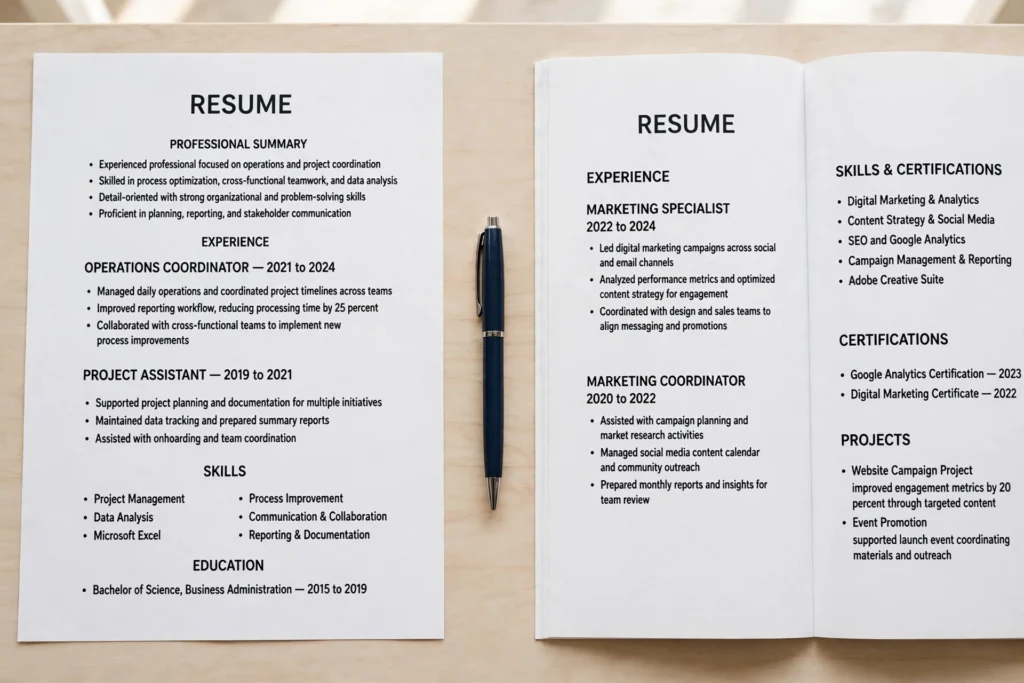
The One-Page Version
Jordan’s one-page version leads with his degree and his internship. The degree takes two lines: Bachelor of Science in Computer Science, 2022–2026, with a final-year project on accessible library software. The internship takes four lines: six months as a software engineering intern at a mid-sized software company, where he built a customer dashboard used by the support team, cut the time to find a customer record from minutes to seconds, and wrote the user guide the team still uses.
Two projects follow, each in three lines. The library management app, built for his college library, now handles borrowing for several hundred students and cut overdue notices by hand. The data dashboard for a local charity shows donations and volunteer hours in one place, and the charity uses it every week. The third project, a small e-commerce site for a family business, is cut entirely: it has no users beyond the family and no result to report, so it fails the test for a developer role.
Skills take five lines: languages, tools, and two certifications the posting names. Activities take two lines: a coding club he helped run, and a hackathon his team won. Nothing else survives. The page is full but not crowded, and every line answers the question “would deleting this change the decision?” with yes. This is the version Jordan sends to most roles, and it is the version most freshers should aim for before they consider a two page resume for freshers at all.
The Two-Page Version
Now suppose Jordan is applying for a role that asks specifically for dashboard work, data visualisation, and client-facing development. The posting names those three things, and his record has more to say about each than one page allows. Page one stays almost the same: degree, internship, and the two strongest projects, each given a little more room to breathe. The difference is on page two.
Page two opens with the e-commerce site that the one-page version cut. For this posting it passes the test, because the role involves building small client-facing sites, and the shop is a finished client site with real orders running through it. It takes four lines: what it sells, what Jordan built, how many orders it handles in a typical week, and the fact that it is still running. The line that was padding for a general developer role is evidence for this one.
Page two continues with the charity dashboard in more depth: the charts Jordan built, the data sources he connected, and the weekly report the charity’s manager now relies on. Then come the certifications, each with its issuer and date, because the posting names two of them. A short section on freelance work follows — two small sites for local businesses, each with a result. Page two ends up about three quarters full, with Jordan’s name and contact details in the header. It looks deliberate, because it is — and that is the standard every two page resume for freshers has to meet on its second page.
What Each Cut Line Teaches
The comparison teaches three things. First, the same line can pass for one job and fail for another. The e-commerce site was cut from the general version and kept for the client-facing version, and both decisions were right, because the test is always “for this job”. A resume that never changes between applications is a resume that has never been tested.
Second, cutting is not losing. The one-page version is not a weaker resume. It is a sharper one, because the reader meets only the strongest evidence and meets it quickly. Jordan’s one-page version would beat his two-page version for most roles, because most postings do not ask for the extra detail. The two-page version wins only where the posting asks for depth, and only because its second page is full of material the posting named.
Third, the second page has to be earned by the posting, not by the writer’s wishes. Jordan did not add a page because he wanted more room. He added it because the posting asked for three things his one page could not prove in the space available. If your second page exists because you want it to, cut it. If it exists because the posting demands it, keep it, and make sure every line on it can point at the posting and say why it is there.
How to Cut Back to One Page, in Order
Most freshers who try the test will find their second page does not earn its space. That is normal, and the fix is a method, not a mood. Work through the cuts in the order below, and stop as soon as the page fits. Each step removes the weakest material first, so the lines that survive are the ones that matter most. Do not start by shrinking the type or narrowing the margins: that is a two-page resume in disguise, and a recruiter who prints it will see through it at once. The goal is not to punish a two page resume for freshers, but to find out whether yours is one.
First, cut the sections that never pass the test. Hobbies go, references go, and the generic skills list goes. That alone often frees a quarter of a page. If you have a coursework list, cut it to the three or four entries the posting touches, or cut it entirely. These are the easy cuts, and they cost nothing, because nothing a recruiter needs is in them. They are also the first step toward deciding whether a two page resume for freshers is really what your record needs.
Second, cut the weakest lines inside the sections that survive. A bullet that describes a duty — “responsible for updating the website” — goes before a bullet that describes a result. A project with no users and no outcome goes before a project with both. An older entry goes before a recent one. Work section by section, and keep the test beside you: would deleting this line change the decision for this job? If not, delete it.
Third, tighten the wording of the lines that remain. Most freshers write bullets at twice the length they need. “Worked as part of a team of four students to design and build a library management system for the college library, which is now used by students to borrow books” becomes “Built a library management system with three classmates, now used by several hundred students for borrowing”. Same facts, half the words, and the result is easier to see. Do this for every bullet, and a page often comes back on its own.
Fourth, and only now, look at the layout. The guide to best fonts formatting fresher resume choices covers sizes, margins, and spacing properly, and the short version is this: keep the body type at a readable size, keep the margins honest, and let the content decide the length. A page that fits only because the type is tiny is not a one-page resume. It is a two-page resume that a tired reader will not finish. For a clean starting point that keeps the layout honest, the free templates on ResumeForg give you a one-page structure that does not need shrinking to work.
If you have worked through all four steps and the page still does not fit, stop and re-read the test. Either the record genuinely earns a two page resume for freshers — in which case, keep both pages and make sure page two is full — or one of the sections you kept is still carrying lines that fail. It is almost always the second. Go through the page once more with the posting beside you, and be honest about the lines you kept because you like them rather than because the job needs them.

Page-Break Rules That Keep Both Pages Clean
A two-page resume can fail on mechanics even when its content passes the test. The most common failure is an orphan heading: a section title sitting alone at the bottom of page one, with its content starting on page two. It looks like a mistake, because it is one. Check the break before you send the file, and move the heading to page two with its section if it does not fit with at least two lines of content on page one.
The same care applies to bullets. A bullet that splits across the page break, with its first line on page one and its second on page two, is hard to read and easy to miss. Keep each bullet whole on one page, even if that leaves a little white space at the bottom of page one. White space is not a flaw. A broken bullet is.
Strongest work still belongs on page one, even in a two-page resume. A recruiter may not turn the page, and a resume that hides its best evidence on page two is gambling on a turn that might not come. Put the degree, the best internship, and the strongest project on page one, and let page two add depth to a case that is already made. Page two should strengthen a decision, not introduce it.
Finally, check the file the way the recruiter will receive it. Open the PDF, look at both pages, and read page two on its own. Does it make sense without page one beside it? Does it open with something strong? Does it carry your name? A two page resume for freshers that reads cleanly on both pages, in either order, is a document its writer can trust. One that only works when both pages are read together is a document that will be misread the first time it is printed and separated.
Frequently Asked Questions
Is a two page resume for freshers acceptable to recruiters?
Yes, when the second page earns its space. That is the short answer to whether a two page resume for freshers is acceptable: length is never the problem, padding is. Recruiters do not reject a resume for having two pages. They reject it for having two pages with one page of content, because that tells them the writer could not edit. A second page full of relevant internships, projects, or certifications the posting asks for reads as a strong record, not a long one. The test in this guide — would deleting this line change the hiring decision for this job — is the same judgement a recruiter makes, so apply it before you send the file.
How long should a resume be for freshers in most cases?
One page, for most freshers. A degree, one internship, a few projects, and a skills section fit comfortably on a single page when they are written tightly, and a single page is easier for a recruiter to read in full. Two pages are the exception, not the rule, and they belong to the narrow cases in this guide: a strong internship plus major projects, a publication, several substantial internships, or a certifications list the job names. If your record is the usual one, a tighter one page is the stronger document.
Can a two page resume for freshers hurt my chances?
It can, but only when the second page is padding — and that is the real risk of a two page resume for freshers, not the length itself. A page two that holds hobbies, a long coursework list, or generic skills tells the reader that the writer could not tell evidence from filler, and that judgement colours the rest of the page. A page two full of real results does the opposite: it shows a record too strong to fit on one page. The risk is not the length. It is what the length contains, and the test in this guide is how you check it before the recruiter does.
What is the 2 page resume format I should follow?
The format is the same as a good one-page resume, extended, not reinvented. For a recent graduate, the college graduate resume format is the same structure with the same rules: education first, then experience, then projects, with the second page carrying depth rather than decoration.
One font family throughout, a readable body size, honest margins, clear section headings, and bullets that lead with results. Page one holds the degree, the best internship, and the strongest project. Page two opens with the next strongest evidence, carries your name and contact details in a header, and ends when the evidence ends. The free templates on ResumeForg include a clean two-page layout, and the best fonts formatting fresher resume guide covers the size and spacing choices that keep both pages readable.
Should I use a 1 page resume format or a 2 page resume format?
Use the 1 page resume format unless your record passes the test in this guide for a specific job. The choice is not about which format is better in general. It is about which format fits the evidence you have for the posting in front of you. If the posting asks for depth your one page cannot show, use two pages and fill the second one properly. If it does not, use one page, and spend the time you saved making each line on it stronger. Keep both versions ready, and choose per application, not per habit.
That is the practical way to choose between a one-page resume and a two page resume for freshers: test the record against the posting, then pick the format the evidence supports.
How do I know if my second page is full enough?
Look at it. A second page less than about two thirds full reads as overflow, and the honest fix is usually to cut back to one page rather than to stretch the content. Check the shape with your own eyes rather than measuring it precisely: does page two look like a page, or like a leftover? If it looks like a leftover, tighten page one, merge short bullets, and cut the weakest lines until what remains fits. If what remains is still more than a page of real evidence, your two pages are justified.
Do recruiters read the second page at all?
They read it when page one earns it. A strong first page — a relevant degree, a solid internship, a project with a real result — makes a recruiter want to know more, and they turn the page. A weak first page does not get a second look, whatever is on page two. That is why the strongest work always belongs on page one, and why page two should open with evidence rather than filler. The second page is a reward for a good first page, not a rescue for a weak one.
A Short Checklist Before You Decide
Run through this list with your draft open and the posting beside you. If you can answer yes to the first four questions, a second page is justified. If you cannot, cut back to one page and send the stronger document.
First, does every line on page two pass the test — would deleting it change the hiring decision for this job? Second, is page two at least about two thirds full at an honest type size and honest margins? Third, does page two open with strong evidence rather than hobbies, references, or a generic skills list? Fourth, does your name and contact details appear at the top of page two?
Fifth, is your strongest work still on page one, so the resume works even if nobody turns the page? Sixth, have you checked the page break for orphan headings and split bullets? And seventh, have you read page two on its own, without page one beside it, to check that it makes sense?
If the answer to any of these is no, fix that item before you send the file. The fix is usually a cut, not an addition, and the resume gets better with each one. A two page resume for freshers is not a goal in itself. It is a format that fits a small number of strong records, and the writers who use it well are the ones who checked every line before they added the page. Decide with the test, not with the wish, and the length will take care of itself.