
A one page resume for freshers is not a shorter version of a long resume. It is a different kind of document: one page, one clear story, and proof that a recent graduate can do the job in front of them. Most freshers do not need a second page, because a second page usually means the first page was not edited hard enough.
What employers want to see, quickly, is education, the most relevant projects or experience, and skills they can trust — in that order, without hunting through unrelated coursework, repeated lines, or filler.
This guide shows you how to build a one page resume for freshers from a longer master resume, how to decide what earns space and what gets cut, and how to format the result so it stays readable for both a human recruiter and an applicant tracking system.
The examples follow one fictional fresher, Jordan Lee, a recent graduate applying for an entry-level role. The same facts appear first as a cluttered draft and then as a tight one page, so you can see that good editing is not about having less experience. It is about choosing the strongest evidence and presenting it clearly.
If you are starting from scratch, it helps to think of this post as the editing stage. First you gather everything you could say, then you cut it to the one page that actually helps you get an interview. That cut-first approach is what keeps a one page resume for freshers honest, readable, and useful, rather than cramped or padded.
Table of Contents
Why a One Page Resume for Freshers Works — and When It Does Not
Recruiters spend very little time on a first scan. They are not reading every line on a first pass; they are checking whether the applicant looks like a plausible fit, and whether the key facts are easy to find. A one page resume for freshers matches that reality. It forces the writer to lead with the strongest material, and it respects the reader’s time. When everything fits on one page, there is nowhere for weak material to hide, and nowhere for strong material to get buried.
There is also a practical reason. A fresher with a degree, one or two internships or projects, and a handful of part-time or volunteer roles rarely has two pages of relevant, distinct proof. Trying to stretch that material to two pages usually produces repetition: the same skill described three ways, a course list that reads like a transcript, or hobbies added only to fill space. Recruiters notice padding quickly, and it weakens the strong material around it.
That said, one page is a strong default, not a law of nature. A second page becomes reasonable when experience genuinely justifies it — for example, after several years of full-time work, or in a field where a longer record is the normal expectation.
A useful contrast is the 2 page resume format: it exists for people whose relevant history cannot honestly be cut to one page without losing important proof. For most freshers, that test fails. If you can cut a line without making your fit for the job less clear, the line should go. The question is never “can I fill two pages?” but “does the second page add proof this employer needs?”
Start With a Master Resume, Then Cut to One Page
Do not try to write a one page resume for freshers from a blank page. Start with a master resume instead. Your master resume is a private, longer document that holds everything: every project, internship, part-time job, volunteer role, course, tool, and achievement you might ever mention. It can run to two pages or more, because nobody sends it. Its job is to make editing possible. When you cut from a complete record, you choose. When you write short from the start, you guess.
Build the master resume in sections, with several bullets under each project or role. Write each bullet with a result where you can, even a small one: how many people you helped, how much time a process saved, or what improved because of your work.
A bullet that only names a task — “helped with the website” — is hard to cut well, because there is nothing to judge it against. A bullet with a result — “updated 40 product pages and fixed broken links, reducing reported errors over two weeks” — can be kept, shortened, or cut on its merits.
Once the master resume exists, copy it and start cutting for a specific kind of role. This is where a 1 page resume format takes shape. You are not shrinking text or squeezing margins to force everything in. You are removing whole lines, merging duplicates, and keeping only the material that proves fit for the job you actually want. If a line would still matter to a different employer, it stays safe in the master file. Cutting it from this version is not losing experience; it is aiming it.
A good test during this stage is to read each remaining line and ask: if this line were deleted, would a recruiter understand my fit any less well? If the answer is no, delete it. Repeat that test until the page fits without tiny fonts or cramped spacing. The result should look calm, not crowded — and that calm is itself a signal of judgement.
The One Page Resume for Freshers Layout, Section by Section
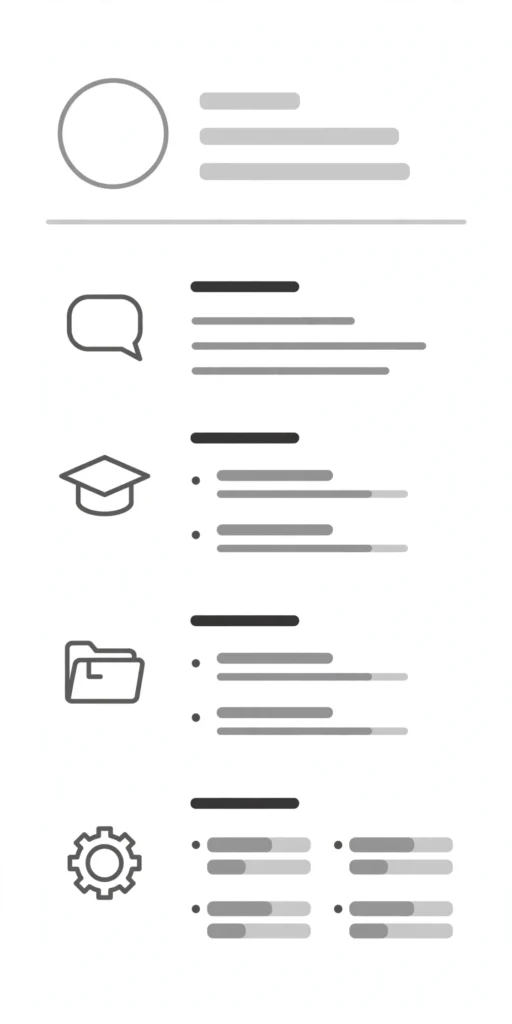
A clear one page resume for freshers follows a predictable order, because predictable order is fast to scan. Recruiters should know where to look without thinking about it. A simple layout that works for most freshers is: name and contact details at the top, a short summary, education, projects or experience, and skills. Certifications or relevant courses can sit in a short line under education or skills, rather than taking a whole section of their own.
Think of the page as a budget. The summary earns two or three lines, no more. Education earns a few lines: degree, institution, graduation year, and one or two relevant details if they genuinely help.
Projects or internship experience earn the largest share, because that is where a fresher shows what they can actually do. Skills earn a compact block, not a long list. Anything that needs more space than its budget allows is probably trying to say too much, and should be shortened or moved back to the master resume.
This is also where a minimal resume template helps. A minimal resume template is not an empty design; it is a design that gives headings, spacing, and bullets room to breathe. One clean font, clear headings, and consistent spacing do more for readability than colour, icons, or decorative lines ever will.
A modern resume design, at its best, looks modern because it is clean and consistent, not because it is decorated. When a template adds columns, graphics, or sidebars, ask whether it helps a recruiter scan faster. If it does not, it is costing you space you cannot afford on one page.
What to Keep: Education, Projects, Internship, Skills — in Priority Order
For a student resume with no experience in full-time work, the priority order matters more than the number of sections. Recruiters for entry-level roles expect limited work history, so they look first for learning and for applied work: what you studied, what you built or contributed to, and what tools you can use. Put those things first, and in that order.
Education comes first for most freshers, because it is the most recent and most complete record they have. Keep it short: degree title, institution, and graduation year, plus a relevant module, project, or result only if it connects to the role. A long list of every module you ever took belongs in a transcript, not on a one page resume for freshers. Choose the modules that prove something the employer asked for.
Projects and internships come next, and they should carry the most detail on the page. For an entry level resume no experience in a full-time job, a university project, a freelance task, or a short internship is real experience, provided it is described honestly.
Two or three strong bullets per project are enough. Lead each bullet with an action verb for resume writing — built, organised, analysed, supported, improved — and follow it with what happened. “Organised weekly study-group sessions for 25 students and shared clear notes after each session” tells a recruiter far more than “good team player.”
Skills come last in this order, but they still need care. Professional skills for resume sections should be specific and honest: name tools you have actually used, languages you can actually work in, and workplace skills you can show with an example elsewhere on the page.
A skills list that repeats everything mentioned in the projects wastes space. A skills list that adds one or two genuinely new, relevant skills earns its place. If a skill appears nowhere else and you cannot explain it in an interview, leave it out.
What to Cut First: Older, Irrelevant, and Repeated Lines
Cutting is the hardest part of a one page resume for freshers, because every line once felt important. A simple order helps. Cut repeated lines first: if two bullets prove the same skill with the same example, keep the stronger one and delete the other.
Then cut older, less relevant material: a short school-era role that adds nothing to the job you want now, or a course from years ago that no longer connects to your target role. Then cut detail that belongs in an interview, not on the page: the full story behind a project can wait until you are asked about it.
Also cut lines that describe the job rather than your contribution. “Responsible for customer service” describes a role. “Answered around 30 customer queries a week by email, resolving routine account questions and passing complex cases on with clear notes” describes work. The second version earns space; the first does not, because it could describe anyone who held the role. When you cut, you are not only saving space. You are raising the average quality of every line that remains.
Be especially careful with hobbies and interests on a one page resume for freshers. A hobby earns space only when it proves something relevant — for example, running a small community project that shows organisation, or maintaining a personal project that shows a technical skill.
A list of general hobbies, added only to fill the bottom of the page, signals that the writer ran out of relevant proof. It is better to leave white space at the bottom of a one page than to fill it with material that weakens the page above it.
Before and After: Jordan Lee, From Cluttered Draft to One Page
Jordan Lee is a recent graduate applying for an entry-level support and administration role. Here is the same experience first as a cluttered draft — the kind of draft many freshers start with — and then as a tight one page resume for freshers. The facts do not change. The editing does.
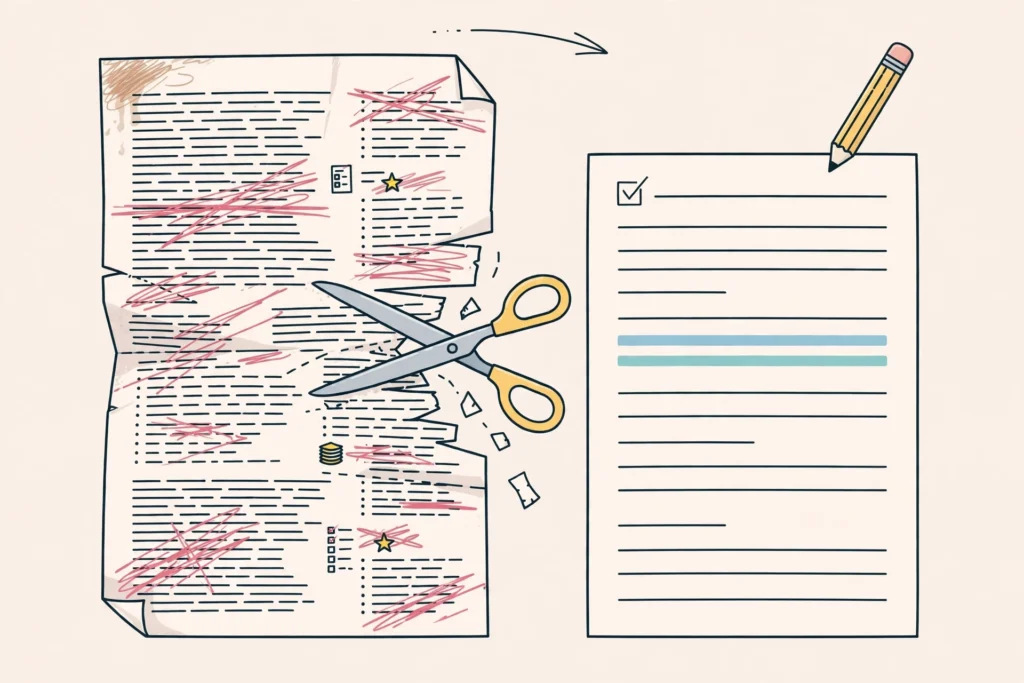
The cluttered draft runs long because it tries to say everything. It lists every module, repeats communication skills in three sections, describes a part-time campus help-desk role in five vague bullets, and adds a paragraph of general interests at the end. It also uses two different fonts, inconsistent headings, and narrow margins to force it all in. A recruiter scanning it has to work hard to find the relevant proof, and the effort is not rewarded, because much of the text repeats itself.
The one-page version keeps the same person and the same history, but makes different choices. The summary is two lines: recent graduate, help-desk and organisation experience, applying for a support role. Education is three lines, with one relevant module named.
The help-desk role is two bullets, both with results: around 30 queries a week answered by email and in person, and registration records for 200 members kept accurate in a spreadsheet. One university project is shown with two bullets, and skills are a single compact line. Nothing is invented, and nothing important is lost. The page is simply easier to trust, because every line earns its place.
Notice what the one-page version does not do. It does not shrink the font to fit more in. It does not hide the lack of full-time experience behind tiny text. And it does not add a second project, a longer skills list, or a hobbies paragraph to fill space. That restraint is the point. A one page resume for freshers works when the writer is willing to leave good material in the master resume for another application, rather than forcing it onto this page.
Formatting That Stays Readable: Font, Margins, Headings, Bullets
Formatting rules for a one page resume for freshers are simple, and they are worth following exactly, because they protect readability when space is tight.
Use one clean, common font throughout, in 10 to 12 point size for the body text. Use slightly larger, bold text for your name and section headings, and keep headings consistent from section to section. Use margins between 0.5 and 1 inch, so the page does not look squeezed at the edges. Use bullet points for project and experience details, and keep each bullet to one or two lines where possible.
University career services give the same advice in very similar terms, which is reassuring: it means these are shared professional standards, not one writer’s preference. The University of Nebraska-Lincoln career guide gives the same one-page limit for most applicants, the same font and margin ranges, and warns against tables, grids, and photos that can break how a resume is read.
That guide is linked here because formatting is exactly where a trusted, specific source matters more than general advice.
Short paragraphs and short bullets also help a human reader. A block of dense text on a one page resume for freshers is hard to scan, even if every sentence is good.
Break long descriptions into two bullets. Start bullets with strong verbs. Leave white space between sections. White space is not wasted space; it is what lets the reader’s eye move from one section to the next without getting lost. If your page looks crowded, the answer is almost always to cut a line, not to reduce the font size or narrow the margins further.
Keep It ATS-Readable: What to Avoid
Many employers use applicant tracking systems, software that reads a resume before a human sees it. A one page resume for freshers must therefore be readable by software as well as by people. The good news is that the same choices that help a human — clear headings, one column, standard section names, simple bullets — also help automated readers.
ATS friendly resume templates are, at heart, simple templates: one column, standard headings such as Summary, Education, Projects, Experience, and Skills, and text that can be selected and copied in reading order.
Avoid the features that break that reading. Do not use two columns, tables, text boxes, graphics, icons in place of words, or photos inside the body of the resume.
Do not hide keywords in white text, and do not use unusual symbols for bullets. Do not save the resume as a scanned image. A text-based PDF, saved from a clean document, preserves both layout and readability in most cases. Before sending, open the PDF, select the text, and copy it into a plain document: if it pastes in a sensible order, an automated reader is likely to read it in that order too.
The University of Nebraska at Omaha career services guidance makes the same point from the student side: keep the resume to one page in a simple, clean format, and use bullets that show achievements with numbers where possible. That combination — one page, simple format, achievement bullets — is exactly what both a recruiter and a tracking system can work with.
Indeed’s guide to how long a resume should be reaches the same conclusion for entry-level candidates: one page is the ideal length, especially for recent graduates. These are independent sources pointing the same way, which is why this guide treats one page as the default for freshers, not as a matter of taste.
Common One Page Resume for Freshers Mistakes: Tiny Fonts, Cramming, Padding
The most common mistake in a one page resume for freshers is shrinking the font to fit too much in. A resume in 8 point type may technically fit on one page, but it is unpleasant to read, and it signals that the writer could not decide what mattered. Recruiters will not struggle through tiny text to find good material. They will move on. If your resume only fits at 8 or 9 points, cut material until it fits at 10 points or above.
The second mistake is cramming: removing all spacing, narrowing margins below half an inch, and packing bullets together until the page looks like a wall of text. Cramming has the same effect as tiny fonts. It makes a one page resume for freshers look desperate rather than disciplined. Spacing is part of the message. A page with breathing room looks confident, because it suggests the writer chose their best material and is comfortable leaving the rest out.
The third mistake is padding, the opposite problem: adding irrelevant jobs, long hobby lists, or repeated skills to fill a page that would otherwise look short. Padding is easy to spot, and it dilutes the strong material. A one page resume for freshers does not need to fill every inch of the page. A clean page that ends naturally, with a little white space at the bottom, is far better than a page padded to the edge with filler.
The fourth mistake is using a fancy two-column or heavily designed template that looks impressive on screen but breaks when it is parsed or printed. Columns, sidebars, and graphics often read out of order in tracking systems, and they eat space that a single column could use better. A college graduate resume format should look professional because it is clear and consistent, not because it is decorated. If a template makes your resume harder to read, it is not helping you, however modern it looks.
Tailor the One Page Per Job Without Rebuilding It
A one page resume for freshers is not a single document you send everywhere. It is a base you adjust for each role, quickly, from your master resume. The adjustment is small: rewrite the summary for that role, reorder the skills so the most relevant ones come first, and swap in the project bullets that best match the job description. Everything else — the layout, the headings, the font — stays the same. That stability is what makes tailoring fast and safe.
This is where the daily series connects. A full guide to tailoring is available in the post on how to tailor your resume for each job, which explains how to read a job description, choose keywords honestly, and keep one master resume with many targeted copies.
The link to that guide is in this section because tailoring is the step that turns a good one page into a good one page for this specific job. Read that guide after this one if you want the full tailoring process, and use it each time you apply.
Tailoring a one page resume for freshers should make the page shorter or clearer, never longer. If your tailored version spills onto a second page, that is a sign to cut more, not to shrink the font.
A useful rule is to change no more than the summary, the skills order, and two or three bullets per application. More change than that usually means you are rewriting rather than tailoring, and rewriting from scratch for every job is slow and error-prone. Keep the master resume updated, copy it, tailor lightly, proofread, and send.
Quick One-Page Checklist Before You Send
Run through this checklist before sending any one page resume for freshers. It takes five minutes and catches most errors.
First, does the page fit on one page at 10 to 12 point font with normal margins, without cramming? Second, does the summary name the kind of role you want, in two or three lines? Third, are the top three bullets the strongest proof for this specific job, with results where possible? Fourth, does every skill appear honestly, with an example somewhere on the page or in your master resume to back it up?
Fifth, check the format: one column, standard headings, simple bullets, no tables, graphics, or photos in the body.
Sixth, save the file as a PDF unless the posting asks for another format, and name it clearly — for example, Jordan-Lee-Resume.pdf — so the employer can find it again. If you are using a free resume builder, choose a simple, clean template and export as a text-based PDF, then open the PDF and check that the text selects and copies in the right order. A pdf resume builder is only useful if the file it produces can actually be read by the employer’s system.
Seventh, proofread slowly, out loud if you can, checking names, dates, and spelling, and checking that you have not left a previous employer’s name or role title in from an earlier version.
Finally, check the basics that are easy to miss on a short document: an email address you actually check, a phone number in a standard format, and no placeholder text left in from a template. A one page resume for freshers has nowhere to hide a careless error, which is why this final read matters so much.
Frequently Asked Questions About a One Page Resume for Freshers
How long should a fresher resume be?
For most freshers, one page is the right length. A one page resume for freshers covers education, the strongest projects or experience, and relevant skills without repetition. A second page is justified only when relevant experience genuinely cannot fit on one page without losing important proof, which is uncommon at the start of a career. If you are unsure, try the one-page version first and ask whether anything important is truly missing.
Is one page enough if I have internships and projects?
Yes, in most cases. One strong internship and two strong projects, described with results, fit comfortably on one page when they are edited well. Choose the internship and projects that best match the role, and leave the rest in your master resume. Showing three projects briefly is usually weaker than showing one or two projects well, because depth proves more than a list of titles.
What font size and margins keep one page readable?
Use a common, clean font at 10 to 12 points for body text, with margins between 0.5 and 1 inch. Keep headings bold and consistent, and leave space between sections. If your resume only fits by going below 10 points or below half-inch margins, cut content instead. Readability is part of the content, not a decoration on top of it.
Should I use two columns or a fancy template?
For most applications, no. Two columns and heavily designed templates can look good on screen but often read out of order in tracking systems and on paper. A single-column, minimal resume template with standard headings is safer and easier to scan. Choose a modern resume design that is modern because it is clean, not because it is decorated.
What should I cut first to fit one page?
Cut repeated lines first, then older or irrelevant material, then detail that belongs in an interview rather than on the page. If two bullets prove the same skill, keep the stronger one. If a course or role does not connect to the job you want, leave it in the master resume. Cutting in that order protects your strongest proof and removes filler first.
Should I include a photo on a one page resume?
In most cases, no. A photo takes space, adds nothing about your skills, and can create problems with automated reading and with fair screening. Unless a posting or a local custom specifically asks for a photo, leave it out and use the space for a stronger bullet or a clearer skills line.
PDF or Word for a one-page resume?
Save as a PDF unless the posting asks for Word or another format. A PDF preserves your layout on any device, and a text-based PDF can still be read by tracking systems. Check the exported file by selecting and copying its text: if it pastes in a sensible order, it is likely to be read correctly. Name the file clearly with your name and the word resume.
When is a second page actually justified?
A second page is justified when you have enough relevant, distinct experience that cutting to one page would remove proof an employer needs to judge your fit. That is common after several years of full-time work, and uncommon for a recent graduate. The test is not whether you can fill two pages, but whether the second page adds proof. For a chronological resume format with a long work history, or a combination resume format that needs to show both skills and a substantial record, two pages may make sense later in a career. For a fresher, one page is almost always the stronger choice.
Final Word: One Page, Chosen Well
A one page resume for freshers is a test of judgement, not a test of how much you can fit. Start from a master resume, cut by relevance, keep the strongest proof, and format the result so it is easy to read for a person and for a tracking system.
Use resume summary examples as a starting point for your own two or three lines, not as sentences to copy. Use action verbs for resume bullets to show what you did, not just what you were responsible for. And build the page with a simple tool — a free resume builder with a clean template, or a plain document — rather than a complicated design that fights the content.
Do the work once, properly, and the one page becomes a base you can tailor quickly for each job. Then, before you send it, run the checklist, save it as a PDF, and read it once more as a recruiter would: does the fit jump out in the first few lines? If it does, the page is ready. If it does not, cut one more line and move your strongest proof higher. That single habit — choosing, cutting, and checking — is what turns a short resume into a strong one, and it is available to every fresher, whatever their experience so far.
For the next step after this page is ready, read the guide to tailoring your resume for each job, and check the guide to resume mistakes for freshers to clear the common errors before you send anything. A clean one page, tailored lightly for each role, and free of the usual mistakes, is the strongest application a fresher can send — not because it is short, but because every line on it was chosen.
2 thoughts on “One Page Resume for Freshers: Perfect Guide 2026”