
A resume tells an employer what you can do, but for a fresher, it also tells a story about how carefully you work. Recruiters often spend only a few seconds on a first scan, and a small mistake can be enough for a good candidate to be passed over. The good news is that most resume mistakes for freshers are easy to fix once you know what to look for.
This guide covers the 15 most common resume mistakes for freshers in 2026, with a simple fix for each one, examples you can copy in spirit, and a final checklist you can use before you send your next application. It is written for students, recent graduates, and anyone applying for a first job or internship, anywhere in the world.
Table of Contents
What Recruiters Actually Notice First
Before the list, it helps to understand how a resume is read. A recruiter usually checks three things in order: is this person relevant for this role, can I understand their experience quickly, and does this look professional and trustworthy?
An applicant tracking system, or ATS, does a similar job automatically. It reads headings, dates, job titles, and skills, and it can miss information if the layout is too fancy, if text is inside an image, or if a section is labelled in an unusual way. That is why a clean, simple layout matters more than a colourful design, especially for a fresher resume.
You do not need a long work history to make a strong impression. You need clarity, relevance, and proof. Every one of the resume mistakes for freshers below breaks one of those three things, and every fix restores it.
1. Sending the Same Resume for Every Job
This is the most common of the resume mistakes for freshers, and the easiest to understand. A fresher creates one resume, then sends it to twenty different roles, from marketing intern to customer support to data entry, without changing a word.
The problem is relevance. A hiring manager for a marketing role does not care as much about a part-time warehouse shift as they care about a social media project, a writing sample, or a class project that shows creativity. When everything is listed equally, nothing stands out.
The fix is not to rewrite your resume from scratch each time. Keep one master resume with everything, then tailor a copy for each job in about fifteen minutes. Change the summary, move the most relevant skills to the top, and reorder your top three or four bullets so the ones that match the job description come first. Remove a bullet that has nothing to do with the role, even if you are proud of it. Tailoring is about choosing, not inventing.
For example, Jordan Lee, a recent graduate applying for a marketing internship, would lead with a university social media project and a part-time role helping a local shop with posters, not with an unrelated summer job, even though both are honest experience. The tailored version feels written for that employer, because it is.
2. A Vague or Missing Summary
Many fresher resumes start with no summary at all, or with a sentence like “Hardworking and motivated graduate looking for a job.” That tells the recruiter nothing specific.
A good fresher summary is short, usually two to three lines, and it answers three questions: what are you studying or what did you just finish, what skills or projects are most relevant, and what kind of role are you looking for?
A better example is: “Recent business graduate with hands-on experience in social media projects, customer service, and basic data analysis. Looking for a marketing internship where I can support campaigns, create content, and learn from a professional team.”
If you have no work experience, a short objective can work instead, but keep it specific. Say the role, the skill you bring, and the value you offer, not just that you want a job. Avoid long paragraphs in the summary. If it takes more than four lines to read, it is too long.
3. Listing Duties Instead of Results
A bullet that says “Responsible for social media” describes a duty, not a result. Recruiters already know what a social media role involves. They want to know what you actually did and what changed.
Use a simple formula: action verb, task, and result or scale. For example, instead of “Helped with events,” write “Helped organise a university charity event for 120 attendees, coordinating volunteers and managing registration on the day.”
Freshers often think they have no results because they have no full-time job. Projects, societies, volunteer work, and part-time jobs all count. Did you increase followers, save time, serve a certain number of customers, raise money, or finish a project on time? If you can put a number on it honestly, do it. Numbers make a bullet believable and easy to scan.
Avoid inflating numbers. If you helped a team that reached 500 people, say you supported a team that reached 500 people, not that you personally reached 500 people. Honesty builds trust, and it is easier to explain in an interview.
4. A Resume That Is Too Long, or Too Short in the Wrong Places
For most freshers, one page is enough. A two-page resume with large gaps, repeated information, or a long list of school activities from years ago looks unfocused. On the other hand, a half-page resume with only a name and a degree, and no projects or skills, looks unfinished.
The fix is to aim for one full, well-filled page. Include a short summary, education, skills, projects or experience, and contact details. If you have a second page, it should be because you have genuinely relevant experience that adds value, not because the font is large or the margins are wide. Remove old school details that no longer matter, and keep only what helps for the roles you want now.
Check the balance. If one section takes up half the page and another is only one line, move or cut content until the page reads evenly. A recruiter should see your strongest points without hunting through filler.
5. Typos, Grammar Errors, and Inconsistent Formatting
A single typo will not always end an application, but several typos send a clear message: this person did not check their work. For a fresher, that matters even more, because the resume is often the only proof of attention to detail. That is why proofreading is one of the simplest ways to avoid resume mistakes for freshers.
Common problems are inconsistent dates, mixed bullet styles, different fonts, capitalisation that changes from section to section, and spacing that looks uneven. A resume that looks messy is harder to trust, even if the content is good.
Fix it in three passes. First, run a spell checker. Second, read the resume out loud, slowly, from the bottom to the top, so you notice words instead of skimming meaning. Third, check formatting: one font, one bullet style, one date format, and the same spacing between sections. Ask a friend or mentor to read it once, because a fresh pair of eyes catches errors you have stopped seeing.
6. An Unprofessional Email Address or File Name
An email address you created as a teenager can work against you, even if your resume is strong. A nickname, a joke name, or a long string of numbers looks careless to a hiring manager. The same applies to file names. “Resume_final_FINAL2.pdf” is confusing and hard to find later.
Use a simple, professional email address based on your name. A good file name format is Firstname_Lastname_Resume.pdf. For example, Jordan_Lee_Resume.pdf. That name is clear, professional, and easy to search.
When you send a resume by email, use a clear subject line too, such as “Application for Marketing Intern – Jordan Lee.” Small details like this show that you take the application seriously, and they make it easier for the recruiter to find you again.
7. Including Irrelevant Personal Information
Some fresher resumes include details that do not help an employer decide, such as age, marital status, religion, a full home address, a national ID number, or a photo, when it is not requested. In many countries, including this information can also create bias, even if that is not the intention.
Keep the header simple: your name, phone number, professional email address, city or general location if the job asks for it, and a professional profile link such as LinkedIn, if you have one. That is enough for a recruiter to contact you.
Do not add a photo unless the job posting specifically asks for one, or unless it is normal practice in the country where you are applying and you are comfortable doing so. Your skills and experience should be the focus, not personal details.
8. A Skills Section That Is Just a List of Buzzwords
A skills section that says “hardworking, team player, fast learner, good communication, leadership, problem-solving” does not help much, because every applicant can claim the same words. Recruiters look for skills they can test or see in action. A list of vague claims is one of the resume mistakes for freshers that makes a resume easy to skip.
List skills that match the job, and show them in context. Instead of only writing “communication,” include a bullet that shows communication in use, such as presenting a project to a class or handling customer questions in a part-time role. Keep the list focused: ten relevant skills are stronger than twenty vague ones.
Separate hard skills, such as a software tool, a language, or data analysis, from soft skills, if that helps the reader. Most importantly, do not list a skill you cannot explain or demonstrate. If you claim basic Excel, be ready to explain what you can do with it.
9. Hiding Education in the Wrong Place, or Listing It Poorly
For a fresher, education is often your strongest section, so do not hide it at the bottom under a long list of short courses. Put education near the top, after the summary, with the degree or qualification, the institution name, and the dates or expected graduation date, clearly shown.
Include your grade or GPA only if it is strong and relevant, or if the job posting asks for it. You can also add relevant coursework, a final-year project, or academic achievements, but only if they relate to the role. A long list of every subject you studied is not helpful.
If you are still studying, say so clearly, for example: “BSc Business, expected 2026.” That avoids confusion about whether you have finished, and it shows you are planning ahead.
10. No Projects, Volunteer Work, or Part-Time Experience
Many freshers leave out experience because it was not a full-time job. Leaving that experience out is one of the resume mistakes for freshers that weakens an otherwise strong application. A class project, a society role, freelance work, a part-time job, or volunteer work can all show skills an employer wants, such as teamwork, reliability, organisation, and communication.
A class project where you researched, planned, and presented findings is experience. A part-time job where you handled customers, managed cash, or worked in a team is experience. Organising a society event shows planning and leadership, even if it was unpaid.
Give each item the same structure as a job: what it was, when it happened, and two or three bullets about what you did and what resulted. Do not label it “unimportant” or apologise for it. If it shows a relevant skill, it belongs on the resume.
11. A Fancy Design That Breaks ATS Reading
Columns, tables, icons, graphics, and text boxes can look impressive, but they often confuse an ATS. The system may read the columns in the wrong order, miss a section, or fail to read text inside an image. A human reader may also find a busy layout harder to scan.
For most applications, use a simple single-column layout, standard headings such as Education, Experience, Projects, and Skills, and a common font. Avoid putting important information only in a header, footer, or image, because some systems do not read those parts well.
Keep one clean version as your master, and use it for online applications. If you want a more designed version for handing out in person, keep it separate, but do not send the designed version through an online form unless the employer asks for it.
12. Lying, Exaggerating, or Copying a Template Word for Word
It can be tempting to copy a template, or to stretch a role to sound more senior than it was. This usually backfires. Recruiters read many resumes, and copied phrases stand out. In an interview, a claim you cannot explain will be obvious, and a lie about a qualification or job can end the process immediately.
Use templates for structure, not for content. Write your own bullets, in your own words, based on what you actually did. If you were a team member, say so. If you supported a project, say you supported it. Honest, specific details are more convincing than impressive-sounding claims that fall apart on closer inspection.
13. Forgetting to Match Keywords From the Job Description
Job descriptions use specific words for skills, tools, and duties. If your resume never uses those words, an ATS may not rank it well, and a human reader may not see the match. This is not about stuffing keywords. It is about using the same language the employer uses, when it honestly applies to you. Checking your wording against the posting is a practical way to avoid resume mistakes for freshers.
Read the job description and highlight three or four key skills or tools. Then check whether those words appear naturally in your summary, skills section, or bullets. If you have the skill, name it exactly as the employer names it. If you do not have it, do not claim it. Instead, show the closest related skill, and be honest about your level.
For example, if a posting asks for “basic data analysis” and you completed a class project analysing survey results, say “basic data analysis” in your skills, and describe the project in a bullet. That connection makes it easy for both a system and a person to see the fit.
14. No Proofreading for the Specific Job
Even a well-written resume can fail if it is sent to the wrong job, with the wrong company name, or with a summary that mentions a different role. This happens when a fresher copies a previous application and forgets to update it.
Before you send each application, check three things: the company name, the job title, and the skills or summary that should match that role. Also check that any attached files are the correct version. For example, a cover letter or summary that says you are applying for a customer service role, sent with an application for a design internship, will confuse the recruiter and weaken an otherwise good resume.
Read the final version once, slowly, as if you are the recruiter. If a sentence does not fit this job, change it or remove it. A five-minute check can save an application.
15. Sending Without a Final Checklist
The last mistake is skipping the final check altogether. A resume may be strong, but a missing phone number, a broken link, a file that will not open, or a wrong attachment can stop it from being read at all.
Before you press send, open the file you are actually sending, not an earlier draft. Check that it opens, that the layout looks right, that your contact details are correct, and that links work. Check that you have attached the right file, and that you have followed the instructions in the posting, such as the file format or subject line.
A final checklist takes two minutes, but it catches the errors that are hardest to fix after sending. Make it a habit for every application, not just the important ones.
How to Fix Resume Mistakes for Freshers in One Hour
You do not need a whole weekend to fix resume mistakes for freshers. Set aside one focused hour, and work in order, so you fix the biggest problems first.
First, spend ten minutes on the basics. Fix your contact details, file name, and summary, and remove any personal details that do not belong. Check that your education is in the right place and clearly dated.
Next, spend twenty minutes tailoring your summary, skills, and top bullets to that job. Rewrite duty-based bullets into result-based bullets, and add numbers where you honestly can. Cut anything that does not help for this role, even if it was hard work to do.
Then, spend fifteen minutes on formatting. Use one font, one bullet style, and one date format. Check that headings are clear, that the layout is single-column, and that the resume fits on one page, or close to it.
Finally, spend fifteen minutes proofreading. Read it out loud, check the company name and job title, and run the final checklist below. If you can, ask someone else to read it once before you send it.
A Simple Before-and-After Example
Before: “Hardworking graduate looking for a job. Responsible for social media and events. Good communication skills.”
After: “Recent business graduate with hands-on experience in social media projects and event organisation. Helped organise a university charity event for 120 attendees, coordinating volunteers and managing registration. Looking for a marketing internship where I can support campaigns and create content.”
The second version is not longer by much, but it is specific. It names the degree area, shows a real project, gives a number, and states the role wanted. That difference is why fixing resume mistakes for freshers matters: it turns a resume that gets skimmed into one that gets shortlisted.
Frequently Asked Questions
How long should a fresher resume be?
For most freshers, one page is ideal. It forces you to focus on the most relevant skills, projects, and experience, and it is easier for a recruiter to scan. A second page is only worth it if the extra content is genuinely relevant to the job. Keeping it to one page also helps you avoid resume mistakes for freshers such as padding with irrelevant detail.
Should freshers include a photo on a resume?
In most cases, no. A photo is not needed to judge your skills, and it can create bias. Only include a photo if the job posting specifically asks for one, or if it is normal practice in the country where you are applying.
Is it okay to have no work experience on a fresher resume?
Yes. Employers expect freshers to have limited work experience. Use projects, coursework, volunteer work, societies, and part-time jobs to show skills. What matters is that you show what you did and what you learned, not that you held a full-time job.
Should I use a PDF or Word file for my resume?
PDF is usually the safest choice, because it keeps your layout the same on any device. Follow the job posting if it asks for a specific format. If no format is given, send a PDF with a clear file name, such as Jordan_Lee_Resume.pdf.
How often should I update my resume?
Update your master resume whenever you finish a project, learn a new skill, or gain new experience. For each application, tailor a copy to that job to avoid common resume mistakes for freshers, rather than sending the same version everywhere. A short update before each application is better than a large rewrite once a year.
What is the biggest resume mistake freshers make?
Sending the same generic resume for every job is the biggest of the resume mistakes for freshers, because it makes even good experience look irrelevant. Tailoring your summary, skills, and top bullets to each role, and proofreading for that specific job, will improve your chances more than any design change.
Resume Mistakes for Freshers: Quick Checklist Before You Send

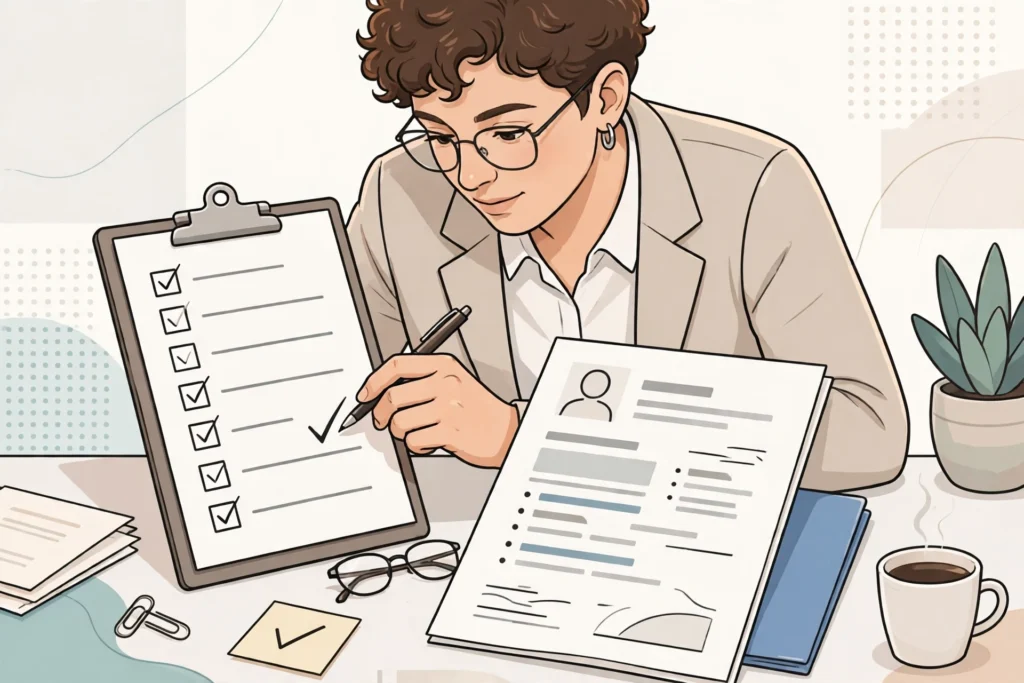
Before you send your next application, run through this checklist for resume mistakes for freshers. Is your summary specific to this role? Have you tailored your skills and top bullets to the job description? Are your bullets result-based, with numbers where possible? Is your resume one page, with one font, one bullet style, and one date format? Have you removed irrelevant personal details and checked your email address and file name? Have you proofread for typos, and checked the company name and job title? Have you opened the final file to make sure it looks right and the links work?
If you can answer yes to all of these, your resume is ready to send. A fresher resume does not need to be perfect, or to list years of experience. It needs to be clear, honest, tailored, and easy to read. Fix the resume mistakes for freshers one at a time, use the checklist before every application, and your resume will stand out for the right reasons.
1 thought on “15 Resume Mistakes Freshers Make in 2026 – and How to Fix Each One Fast”