
Most students write the education section for students on their resume in about thirty seconds. Degree, school, year, done. Then they spend hours polishing the rest of the page, even though for a student or recent graduate, education is usually the first thing a recruiter checks. It answers the basic screening questions: what did you study, where, when do you finish, and does that match what this job asks for? If those answers are buried, vague, or padded with filler, the rest of the resume has to work much harder.
That is the point of this guide. A strong education section for students is not a longer one. It is a precise one. It gives the reader exactly five core facts, then adds only the extras that strengthen the application for this specific job: a GPA worth showing, a short list of courses that match the posting, an honour stated exactly as it appears on the transcript, or a capstone line that shows applied skill. Everything else comes out.
You will find the rules below, a before-and-after example using one fictional student, and honest answers for the awkward cases: still studying, a degree left unfinished, or no degree at all. Nothing here requires you to invent a qualification you do not have. The education section for students works best when it is short, checkable, and matched to the job in front of you.
Table of Contents
What your education section for students has to prove in a quick scan
A recruiter does not read a student resume the way a tutor reads an essay. They scan it, usually in seconds, looking for reasons to keep going or to set it aside. The education section for students carries a specific job in that scan. It has to prove three things fast: that you hold, or are close to holding, a relevant qualification; that you will be available when the role starts; and that your studies connect to the work, not just to a subject area in general.
That is why vagueness hurts more than a short section does. “University, 2023 to 2026” tells the reader almost nothing. Which university, which degree, and in what subject? A reader who has to guess will usually move on to the next application, where the same facts are stated plainly. Clarity is not a formatting preference here. It is the difference between passing the first screen and failing it.
The same scan applies to screening software. Many employers run resumes through an applicant tracking system before a person ever sees them, and that system looks for recognisable degree titles, institution names, and field-of-study words. Writing the degree in full, with the abbreviation in parentheses, helps both readers: the person sees a proper qualification, and the system can match it to the posting. “Bachelor of Science (BS) in Computer Science” is searchable in a way that “BSc Comp Sci” is not always.
There is one more thing the scan is checking, and students often miss it: consistency. If your education says you graduate in May 2027, but your summary says you are available immediately for full-time work, the reader notices the clash. If one entry uses “May 2026” and another uses “06/2026”, the page looks careless. Small mismatches do not prove you are a bad candidate, but they quietly cost trust, and trust is exactly what a student resume with no experience needs to build.
The 5-line core every entry needs
Every entry in an education section for students should contain the same five facts, in the same order, every time. Once you settle on an order, keep it for every entry on the page. Consistency is what makes the section scannable.
First, the degree in full, with the abbreviation in parentheses for screening systems. Write “Bachelor of Science (BS) in Marketing”, not just “BS Marketing”. If you have a minor that matters for the job, add it on the same line: “Bachelor of Arts (BA) in English, Minor in Media Studies”. Leave a minor out when it has nothing to do with the role; it is an optional detail, not a required one.
Second, the institution in full. Use its official name, not a nickname or a shortened version only people at that school would recognise. Third, the location: city and state, or city and country for an international institution. You do not need the campus address, a postcode, or any contact details for the school. Those belong nowhere on a resume.
Fourth, the graduation date, or the expected graduation date if you are still studying. Use month and year, such as “Expected May 2027”, and use the same format for every entry. Fifth, keep the entry to those facts before you add anything optional. The five lines are the entry. Everything after them is a decision, not a default.
Here is what that core looks like in practice, using a fictional student you will meet again later in this guide:
Bachelor of Science (BS) in Computer Science
State University, Riverton — Expected May 2027
That is two lines, and it already answers the screening questions. A reader knows the qualification, the field, the institution, the place, and the availability date. Anything you add after this should earn its space by answering a question the posting actually asks.
One formatting point matters more than students expect: do not put this section in a table, in columns, or inside a graphic. Plain, consistent text parses cleanly in screening systems and reads cleanly for people. A fancy layout that a system cannot read is worse than a plain one it can. If you are building the page with a template, choose one that keeps education as ordinary text. Our guide to ATS friendly resume templates explains what to check before you commit to a design, and the same plain-text rule applies whether you use a builder or a document you format yourself.
Get the order right, and your education section for students reads as a clear timeline instead of a puzzle the recruiter has to solve.
The order to list your entries
List your entries in reverse chronological order: the most recent or highest qualification first, then work backwards. A recruiter reads from the top, so the qualification that matters most should be the first one they meet. If you hold a master’s degree and a bachelor’s degree, the master’s goes first. If you hold one degree, there is nothing to order, and that is fine.
There are two common exceptions, and both are judgement calls rather than rules. If you transferred between institutions and finished at one school, list the school that awarded the degree. Listing both schools for one degree usually confuses the reader unless an achievement from the earlier school genuinely needs explaining, such as a scholarship or a society role you held there. If you studied at two institutions for separate qualifications, list both, each as its own entry, newest first.
Do not list every school you have ever attended. Short courses, summer schools, and exchange semesters are worth a line only when they add something the degree entry does not already say. A study-abroad semester, for example, can sit as a short line under the main degree entry if the international experience is relevant to the role. A one-week workshop does not need its own entry. When in doubt, ask whether the line helps the reader decide to interview you. If it only proves you were busy, cut it.
Placement is a small decision with a large effect, and it is one of the easiest ways to make an education section for students work harder.
Where to place it: student versus experienced applicant
Placement is a decision, not a habit, and it is the decision that most often separates a good education section for students from a wasted one. The rule is simple: the strongest proof goes first. For a current student or a recent graduate, education is usually the strongest proof on the page, so it sits near the top, directly after the summary or objective. For an applicant with several years of relevant work, experience is the stronger proof, so education moves below it.
This is not about modesty or about following a template in order. Templates usually put Experience before Education because they were designed for experienced hires. A student who copies that order hands the reader an empty or thin Experience section first and buries the degree at the bottom. That is backwards. If your degree is the reason you qualify, let the reader meet it early. ResumeWorded’s guide to where education belongs on a resume.
The crossover point is not a fixed number of years, but a useful guide is this: once you have around three years of relevant work, and that work speaks more directly to the posting than your degree does, move education below experience. Even then, keep the entry complete. It just gets shorter. An experienced applicant’s education section for students is no longer the headline, but it still needs the degree, the institution, and the date, stated cleanly.
There is one more placement case worth naming. If you are changing fields and your new qualification is the bridge into that field, put education near the top even if you have work history, because the new degree is what qualifies you for the new direction. The reader should not have to reach page two to discover the qualification the whole application depends on.
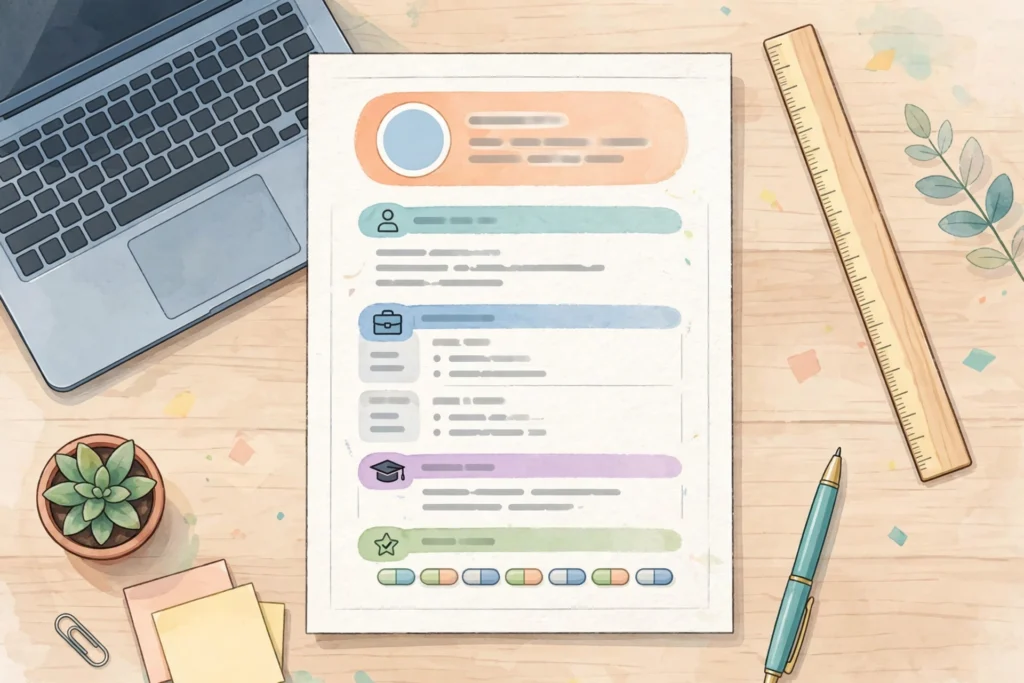
Treat GPA as a single, honest data point in your education section for students, and it will help you; treat it as a decoration, and it will distract from everything else.
GPA: when to include it, when to leave it out, and major GPA
GPA is the most over-shared detail in the education section for students. Many students include it automatically, as if leaving it out looks like hiding something. It does not. Leaving out an average GPA is normal, and including a weak one actively harms the application by drawing attention to the one number that does not help you.
The conservative rule, used consistently across the major resume guides, is to include GPA only when it is 3.5 or higher on a 4.0 scale, and only when you graduated recently or are still studying. Some employers and fields set their own bar, and some guides mention 3.0 as a threshold for early-career applicants, so treat 3.5 as the safe default rather than a universal law. If a posting explicitly asks for GPA, follow the posting, whatever your number is. Otherwise, the test is simple: does this number make the application stronger? A 3.8 does. A 3.1 does not, and the space is better used by a project line or a relevant course.
Write GPA exactly and honestly, with the scale: “GPA: 3.8/4.0”. Never round a 3.4 up to a 3.5, and never present a GPA from one system as if it were another. A recruiter who checks a transcript and finds a different number will trust nothing else on the page either.
Major GPA is a narrower tool. If your overall GPA is modest but your GPA in your major is strong, you may list the major GPA instead, labelled clearly: “Major GPA: 3.7/4.0”. Label it every time. An unlabelled GPA that turns out to be a major GPA reads as misleading when it is discovered, even if you did not mean it that way. And do not list both overall and major GPA unless both are strong and the difference is worth explaining. One number, clearly labelled, beats two numbers that invite comparison.
Age matters here too. Once you are several years past graduation, drop the GPA entirely. At that point your work is the evidence, and a number from years ago adds nothing. The same applies to graduation dates for much older degrees: if the date invites irrelevant judgements and adds no screening value, leaving it out is a reasonable, widely accepted choice.
Chosen well, the coursework line turns an education section for students from a list of qualifications into evidence for this specific job.
Relevant coursework: choosing 4 to 6 courses that match the job
Relevant coursework is the most useful optional line in an education section for students, and the most abused. Used well, it connects a degree to a specific posting: it shows the reader you have studied the subjects this job actually uses. Used badly, it becomes a transcript dump that proves you attended classes, which nobody doubted.
Choose four to six courses, and choose them for the posting in front of you, not for your transcript. Read the job description, note the tools, methods, and subject areas it names, and pick the courses that genuinely match. Use the real course names, not codes and not descriptions. “Database Systems, Data Analysis, Research Methods” means something to a reader. A string of module codes means nothing outside your own department. tailor your resume for each job.
This is also where tailoring pays off most visibly. A student applying for a data role and a marketing role with the same course list is telling both employers that the list was not chosen for them. Swap the courses when the target changes. The degree entry stays the same; the coursework line is the part that moves. That is a small edit with a large effect, because it is the line that shows you read the posting.
What does not belong on this line: courses with no connection to the role, introductory courses in unrelated subjects, and long lists that pad the section. If you cannot explain in one sentence why a course helps you do this job, leave it off. The same discipline applies to a student resume with no experience generally: every line has to earn its place by matching the posting, and coursework is no exception.
A final caution. Coursework is a student and recent-graduate tool. Once you have relevant work experience, drop the coursework line. An experienced applicant listing undergraduate courses looks out of touch, because the work history should now be doing that job. Knowing when to remove a line is part of writing a good education section for students, not a sign that the line was never useful.
Exact wording is what makes an honour believable, and believability is the whole currency of an education section for students.
Honours, awards and scholarships: what counts, and how to word them exactly
Honours belong with the degree entry, and they must match the wording on your transcript or award letter exactly. This is not the place for paraphrase. If your transcript says “Dean’s List”, write “Dean’s List”, with the terms or years it covers, such as “Dean’s List (2024–2026)”. If you graduated with Latin honours, write them in the conventional form, for example “Bachelor of Science (BS) in Computer Science, magna cum laude”, and keep the same placement style for every entry.
What counts is narrower than students often think. Include honours that a reader can verify and that signal academic performance: Dean’s List, Latin honours, a named scholarship, a departmental award, or membership of a recognised honour society. Include them only while you are a student or recent graduate. An award from ten years ago, listed under a degree you earned a decade ago, has usually stopped adding value.
What does not count: attendance certificates, participation awards, and long lists of minor recognitions that dilute the strong ones. One genuine honour stated precisely beats five vague ones. If you won a scholarship, name it and, if the name alone does not explain it, add a short factual note: “Merit Scholarship, awarded to the top 5% of the cohort”. Do not inflate a partial fee waiver into a full scholarship, and do not claim an honour you have not yet received. “Expected” honours do not exist on a resume.
Scholarships sit in the same honesty frame as every other line here. A scholarship line is useful because it is third-party proof: someone else judged your work and rewarded it. That proof only works if the wording is exact. Copy the name from the award letter, check the spelling, and leave it at that. The education section for students earns trust through precision, and honours are where precision is most visible.
A short project line is often the most memorable part of an education section for students, because it is the closest thing to work evidence on the page.
Capstone, thesis and major projects inside the education section for students
A capstone, thesis, or major project is worth a line in the education section for students when it shows applied skill the degree title alone does not. A degree says you studied a subject. A capstone line says what you actually built, analysed, or delivered. For a student resume with no experience, that distinction can be the strongest evidence on the page.
Keep it to one or two lines, and write it as a result, not a topic. A project title alone is not enough. “Capstone: campus event booking system” tells the reader what you worked on. “Capstone: built a booking system used for 12 campus events, handling 400 registrations” tells them what you can do. Name the tool or method where it matters, give a scale or an outcome, and keep the sentence short enough to scan.
The same rule applies to a thesis. Give the title only when the topic is relevant to the role, and add one clause on method or finding. A thesis on an unrelated topic does not need a line, however proud of it you are. Relevance decides, not effort. If the project deserves more than two lines, it probably belongs in its own Projects section rather than inside education, and that is a good problem to have: it means you have evidence worth expanding.
There is also a place for short courses and certifications here, but only where they genuinely fit. A short, relevant course that taught you a tool named in the posting can sit as a single line under education, or in its own short section. A long list of unrelated certificates reads as padding and takes space from the project line that actually proves skill. The test is the same as everywhere else in this guide: does this line help this application, for this posting, right now? Monster’s guide to listing education on a resume.
Use Jordan’s strong version as a template for your own education section for students, then replace every detail with your own true facts.
Jordan Lee before and after: a thin entry versus a strong education section for students
The rules above are easier to see in one example. Jordan Lee is a fictional final-year student applying for a junior data analyst role. The degree is real in structure and invented in detail, and the point is the difference between the two versions, not the specific numbers.
Here is the thin version, the kind of entry many students actually send:
Education
University, 2023–2027
Studied Computer Science
That entry fails every test in this guide. No degree title in full, no institution name a reader can check, no location, no expected graduation month, no GPA decision, no coursework, no project. A recruiter cannot tell whether Jordan qualifies, when Jordan is available, or whether the studies connect to a data role. It is not a short entry. It is an empty one.
Here is the strong version, built with the same facts plus the details that earn their space:
Education
Bachelor of Science (BS) in Computer Science
State University, Riverton — Expected May 2027
GPA: 3.8/4.0 (example figure, shown to illustrate format)
Relevant Coursework: Database Systems, Data Analysis, Statistics for Computing, Research Methods
Capstone: Built a dashboard tracking attendance across 12 campus events, using SQL and spreadsheets, and presented findings to a faculty panel
Honours: Dean’s List (2024–2026)
Read the two versions as a recruiter would. The strong version answers the screening questions in seconds, matches the posting’s language with its coursework, and gives the interviewer three things to ask about: the capstone, the coursework, and the honours. It is longer, but every added line does a job. That is the standard to hold your own entry to. If a line in your education section for students does not do a job for this posting, it is not adding value, however true it is.

Whatever your path, an honest education section for students beats a polished one that falls apart under checking.
Current students, unfinished degrees, and no-degree routes, handled honestly
Not every student path is a straight line to graduation, and the education section for students has honest formats for all of them. The principle never changes: state what is true, in a form the reader can check, and let relevance decide how much detail to give.
If you are a current student, say so plainly with an expected date: “Expected May 2027”. Do not write a graduation year as if you have already graduated, and do not leave the date off in the hope that nobody asks. An expected date is useful information: it tells the employer when you can start full-time work, and it explains why your experience section is short. Pair it with relevant coursework and a project line, and the entry is complete. Our guide to a college student resume for internship covers the same placement logic for internship applications, where an expected date is often the first thing a recruiter looks for. college student resume for internship.
If you left a degree unfinished, you can still list it, and often you should, provided it strengthens the application. List the institution, the years attended, the field of study, and the relevant coursework or credits completed, without claiming a degree you do not hold. “State University, Riverton, 2023–2025 — Completed coursework toward a Bachelor of Science (BS) in Computer Science, including Database Systems and Data Analysis” is honest and useful. “Bachelor of Science (BS) in Computer Science, State University” for a degree you did not finish is not. The difference is one word, and it matters completely. Novoresume’s education examples, including unfinished education.
There is one case where leaving an unfinished degree off is the better choice: when it is old, in an unrelated field, and adds nothing to the application. A degree started a decade ago in a field you left behind does not strengthen a current application, and drawing attention to it costs space. In that case, lead with what does strengthen the application: certifications, recent courses, or project work.
If you hold no degree at all, do not invent one and do not leave the section blank in a panic. Frame what you do hold honestly: certifications, completed courses, and project work, each with the issuing body and the year. “Certificate in Data Analysis, Online Learning Institute, 2025” is a real credential stated plainly. A certification section that is honest beats a degree section that is not, every time, because the first survives a background check and the second does not. Courses and certifications belong on the page when they are real and relevant, and they belong in the same plain format as a degree entry: name, provider, year, and nothing padded around them.
Fix these habits and your education section for students will already be ahead of most of the applications in the pile.
Common mistakes in an education section for students
Most education-section mistakes are not dramatic. They are small habits that quietly weaken the page, and they are easy to fix once you see them.
The first is padding: listing every course, every workshop, and every certificate in the hope that volume looks impressive. It does the opposite. A reader faced with a wall of education detail assumes the writer could not decide what mattered, and stops reading carefully. Cut until every line passes the relevance test.
The second is hiding dates. Some students omit graduation dates entirely, worried about age or about looking too junior. For a student or recent graduate, the date is useful information, not a liability: it explains your experience level and your availability. Omitting it creates a question where there did not need to be one. The exception, as noted above, is for much older degrees, where the date has stopped adding screening value.
The third is inconsistent formatting: one entry with month and year, another with year only; one degree spelled out, another abbreviated; honours listed for one entry and not another without reason. Inconsistency is not a content problem, but it reads as carelessness, and carelessness in the easiest section to get right makes the reader doubt the harder sections. Pick one format and use it everywhere. common resume mistakes for freshers.
The fourth is including high school once a degree is held. There is one narrow exception: a first-year student with a genuinely notable high-school award, or a student whose highest qualification is still high school. Otherwise, high school comes off the page the moment a college degree goes on it. The same applies to school contact details, personal references from teachers, and any line that belongs in an application form rather than on a resume.
The fifth is copying a course list, a template entry, or a friend’s education section for students without adapting it. Screening systems and recruiters both notice generic wording, and a copied entry usually fails the relevance test for your posting anyway. Write your own entry, for your own target, and check it against the posting before you send it.
When every section tells the same story, your education section for students stops being an isolated block and starts being the foundation of the application.
How your education section for students connects to the rest of the resume
An education section for students does not sit alone on the page. It sets up everything that follows, and the rest of the resume should agree with it. If your education lists relevant coursework in data analysis, your projects or experience should show that analysis in action. If it lists a capstone, your summary should not contradict the story it tells. Readers notice when sections disagree, and agreement between sections is what makes a short resume feel coherent.
The summary or objective is the first place to check. A student resume with no experience often opens with an objective that names the target role and the degree in one line: a final-year computer science student seeking a junior data analyst role, for example. That line works because education backs it up two lines later. An objective that promises skills the education section for students never mentions, on the other hand, reads as a claim without evidence. Keep the two sections in the same story. If you need help shaping that opening, our resume summary examples and the guidance on professional skills for resume writing cover how to state a claim you can actually support.
Format is the second connection. A strong education section for students on a badly formatted page still gets misread by screening systems, so keep the whole document to one page while you are a student or recent graduate, and keep the text plain and consistent. Our guide to a 1 page resume format for freshers shows how to fit education, projects, and skills onto a single page without shrinking the text into unreadability, and it is worth reading alongside this guide before you finalise the layout.
The third connection is the cover letter. A cover letter should not repeat the education section for students line by line. It should pick one element, usually the capstone or the most relevant coursework, and explain why it matters for this specific employer. That division of labour is what makes the two documents work together: the resume proves, the letter explains. Our cover letter guide for freshers shows how to make that single point without restating the whole resume. how to write a cover letter for freshers.
Finally, the practical step: build the page with a tool that keeps the formatting clean. A free resume builder that produces a plain, parseable document saves you from fighting margins and tables, and a pdf resume builder output keeps the layout fixed when the file is opened on another machine. Use the tool for the layout, and use this guide for the words. The tool cannot decide which courses to list or whether your GPA helps you. Those decisions are yours, and they are the ones this guide exists to help you make. ATS friendly resume templates.
A checklist only helps if a failed item stops the send, so treat any gap in your education section for students as a reason to edit, not a note for later.
Quick checklist for your education section for students
Run through this list for every application, not just once when you first write the resume. It takes two minutes, and it catches the mistakes that cost interviews.
First, is the degree written in full, with the abbreviation in parentheses, and is the institution named in full with its location? Second, is the graduation or expected graduation date present, in month-and-year format, and consistent with every other date on the page? Third, is education placed where your strongest proof belongs: near the top while you are a student or recent graduate, below experience once relevant work takes over?
Fourth, does every optional line earn its space? GPA only if it helps, coursework only if it matches this posting, honours only if the wording is exact, capstone only if it shows applied skill. Fifth, have you removed high school, unrelated courses, low GPA, and school contact details? Sixth, is the formatting consistent across entries, with no tables, columns, or graphics in the section?
Seventh, does the rest of the resume agree with the education section for students: does the summary name the same story, do the projects use the tools the coursework names, and does the cover letter pick one point rather than repeating the section? If any answer is no, fix that line before you send. A checklist is only useful if a failed item stops the send, so treat a “no” as a reason to edit, not as a note for later.
If you remember one thing from this guide, make it this: a good education section for students is short, checkable, and written for the job in front of you.
Frequently asked questions about the education section for students
Should a student put education at the top of the resume?
Yes, in most cases. If you are a current student or a recent graduate, education is usually your strongest proof, so it belongs near the top, directly after your summary or objective. Once you have several years of relevant work experience, move it below experience, because your work then speaks more directly to the posting than your degree does. The rule is to lead with whichever section proves the most for this specific job.
Should I include my GPA in my education section for students?
Include it only when it helps. The safe default is to include GPA when it is 3.5 or higher on a 4.0 scale and you are a recent graduate or still studying. If a posting explicitly asks for GPA, follow the posting. Otherwise, leave a modest or low GPA out and let your coursework and projects carry the section. Never round a GPA up, and always state the scale, such as 3.8/4.0.
How many relevant courses should I list?
Four to six courses that match the target role, using real course names rather than codes. Fewer than four can look thin if coursework is your main evidence; more than six usually means some of them are not really relevant. Choose the list fresh for each application, based on the posting, and drop the coursework line entirely once you have relevant work experience that proves the same skills.
Do I list high school on my resume if I have a degree?
No, not once you hold a college degree, with one narrow exception: a first-year student with a genuinely notable high-school award. Otherwise, high school takes space from the degree, the coursework, and the projects that actually matter for the role. If high school is your highest qualification, list it with the school name, location, and graduation or expected graduation year.
How do I write an unfinished degree on my resume?
List the institution, the years attended, and the field of study, and state plainly that the degree was not completed, with the relevant coursework or credits you did complete. Never present an unfinished degree as a completed one. If the unfinished degree is old and unrelated to the role, it is usually better to leave it off and lead with certifications, recent courses, or project work instead.
What if I have no degree at all?
State what you do hold, honestly and in the same plain format: certifications with the issuing body and year, completed courses that are relevant to the role, and project work that shows applied skill. A short, honest section survives checking and gives the interviewer something real to ask about. An invented or overstated qualification does neither, and it is the one mistake in this section that can end an application permanently.
Does the education section for students matter for applicant tracking systems?
Yes, because screening systems look for recognisable degree titles, institution names, and field-of-study words. Writing the degree in full, with the abbreviation in parentheses, and using the institution’s official name helps the system match your resume to the posting. Plain text, consistent formatting, and no tables or graphics in the section all help the system read it correctly, which is why a clean one-page layout matters as much as the words themselves.
2 thoughts on “Education Section for Students: Perfect Guide 2026”