
A college student resume for internship is not a smaller version of a graduate resume. It is a different kind of document, written for a reader who already knows you have little or no paid work history and is looking for something else instead: proof that you can learn quickly, finish work to a deadline, and use the tools named in the posting.
If you start from a standard template that puts a large, empty Experience section at the top, you hand that reader a blank page and ask them to believe in you anyway.
A strong college student resume for internship does the opposite. It moves the proof you already have — coursework, projects, part-time work, volunteer roles and society work — to the top of the page, in an order a recruiter and a screening system can both follow in seconds.
This guide shows you how to build that page, step by step, with a complete before-and-after example, a format that parses cleanly, and a checklist you can run before every application.
Many students delay applying for internships because they believe they have nothing to write. That belief usually comes from a narrow definition of experience. Paid, full-time work in the same field is only one kind of evidence, and for a first internship it is the kind almost nobody has.
Coursework is evidence when it produced something you can describe. A lab report, a group project, a hackathon entry, a society event you helped run, a part-time shift where you handled money, customers or stock — all of these show behaviour a hiring manager cares about, provided you describe them with the same structure as a job: what you did, with what tool or method, at what scale, and with what result. An internship resume for students succeeds when it translates student life into that language, honestly and specifically, without inventing titles, inflating a team result into a solo achievement, or padding the page with filler.
Table of Contents
What internship recruiters actually screen for
An internship recruiter is not screening for a long career history. They are answering a short list of practical questions, usually in under a minute. Are you enrolled in a relevant programme, and can you work during the internship term? That is why education and an expected graduation date matter so much on a student resume.
Do you have any usable familiarity with the tools, methods or subject matter in the posting? That is why a project bullet naming a real tool beats a long list of soft skills. Can you finish things, follow instructions, and work with other people without constant supervision? That is why a completed project, a society role with a real responsibility, and a part-time job held for several months all carry weight, even when the work itself was unrelated to the internship field.
What recruiters do not expect from a college student resume for internship is perfection. They do not expect a first-year or second-year student to have already worked in the industry, and they do not expect every bullet to end with a dramatic business result. A result can be modest and still be convincing: a prototype that worked, a dataset of a stated size that you cleaned and analysed, an event that ran for a stated number of attendees, a report your tutor marked well, a process you made faster by a stated number of steps.
What damages a student application is vagueness, not modesty.
Phrases such as “responsible for various tasks”, “helped with projects” and “hardworking team player” tell the reader nothing they can test in an interview, and they waste the one page you have. Specificity is what turns a student resume with no experience into a credible application.
It helps to think of the recruiter as a busy person with a queue, not as a judge of your worth. They will skim the top third of the page first: your name and contact details, a short summary or objective line, your degree and expected graduation, and the first bullet under your strongest section. If that first bullet names a tool from their posting and a concrete outcome, they keep reading. If it is generic, they move on.
Every decision in this guide to a college student resume for internship — section order, project bullets, skills, format — is designed to make that first skim work in your favour.
The right section order for a college student resume for internship
Section order is the single most useful decision in a college student resume for internship, because it decides what the reader sees first. For a first-time internship seeker, the order that works best for most students is: contact details, a short summary, Education, Projects, Experience (part-time, volunteer and society roles), Skills, and then Activities or Awards only if they add something real.
Education sits high because eligibility is a screening question: your degree, your institution and your expected graduation date answer it in one line. Projects sit next because, for a student with no paid history, projects are the closest thing to work samples. Experience follows, not because it matters less as a person, but because a part-time or volunteer role usually proves reliability and teamwork rather than the technical fit the posting asks for first.
For a returning intern writing a college student resume for internship — a student who has already completed one internship in the same field — the order changes slightly. Put that internship first, under Experience or Relevant Experience, and let Projects follow it. The rule is simple: lead with your strongest proof for this specific posting, and keep everything in reverse chronological order within each section, newest first. A recruiter should never have to hunt for your most relevant evidence at the bottom of the page.
One common mistake is to keep the standard template order — Summary, Experience, Education, Skills — and then leave Experience empty or fill it with unrelated roles while your best project sits on page two. Another is to put a large Skills section at the top, full of tools that never appear in any bullet. Skills are claims; bullets are evidence. Evidence should come first.
If you are unsure whether you need a resume or a CV for a particular opportunity, the distinction matters less for most internships than getting this order right, and our guide to the difference between a resume and a CV for freshers explains when each document is expected.
Education first: degree, expected graduation and relevant modules
Your Education section in a college student resume for internship should be short, factual and easy to scan. Include the institution name, the degree title, your major or field of study, and your expected graduation month and year. If your grade or GPA is strong for your institution, include it; if it is not, leave it out and let your projects do the talking.
You may add one line of relevant coursework, but choose only three or four modules that genuinely connect to the internship, and name them in plain words, not module codes. “Database Systems, Data Analysis and Research Methods” means something to a recruiter. A string of codes means nothing outside your own department.
Do not list every module you have ever taken, and do not list high school qualifications once you are well into a degree, unless a specific award is directly relevant to the posting. The same discipline applies to awards and scholarships: one or two genuine honours belong here or under a short Awards line, but a long list of attendance certificates does not. For a college student resume for internship, education is a filter, not the whole argument. It proves you are eligible and on track. The rest of the page must prove you can do useful work.
A useful test for this section is to read it as a stranger would. Can they tell, in five seconds, what you study, when you will be available, and whether you match the posting’s degree requirement? If the answer is yes, the section has done its job, and you can move on to the section that will actually win the interview: your projects. That order is what makes a college student resume for internship easy to screen.
Projects as experience: how to write strong project bullets for a college student resume for internship
This is where a college student resume for internship with no experience is won or lost. Choose two or three projects for a college student resume for internship, not six. A course project, a lab assignment that produced a real deliverable, a hackathon entry, a personal project with a public link, or a society project all qualify, provided you can describe your own contribution honestly.
For each project, give it a clear title, a short context line with dates, and two bullets. A title such as “Course Project: Sales Data Dashboard” with the line “Database and Visualisation Course, September to December 2025” tells the reader what it was and when it happened. A vague heading such as “University Project” tells them nothing.
Write each bullet with a simple formula: action verb, plus tool or method, plus task, plus scale or outcome. Start with a strong verb — built, analysed, designed, coordinated, tested, cleaned, presented — and avoid weak openings such as “responsible for” or “helped with”. Name the tool from the posting where you genuinely used it, and give the bullet a number, a scope or a result.
“Built a weekly sales dashboard in Excel and SQL for a 12-week sample dataset of 4,000 records; flagged three product groups that accounted for most returns in the sample” is a bullet a recruiter can ask about. “Worked on data analysis for a group project” is not. The number does not need to be a business result. Scope counts: records cleaned, users tested, pages written, attendees served, tests passed. Specificity is the proof.
Honesty matters most in group work. If a project was a team effort, name your own component. “Designed the survey and analysed responses from 86 participants; presented the findings to a class of 40” is stronger than claiming the whole project, and it protects you in an interview, where a recruiter will naturally probe the project in detail.
Interviewers ask about projects precisely because there is less else to ask about, so every bullet should describe work you can explain for two minutes without hesitation. If you cannot explain a tool you listed, remove it from the bullet and from the Skills section. A guide to writing a resume for internships with no experience makes the same point well: rename an empty Experience section to Projects, and let coursework and club work carry the proof, rather than apologising for a history you do not yet have.

What to do with part-time, volunteer and society roles
Part-time, volunteer and society roles belong on a college student resume for internship, but they need the same discipline as projects — and that discipline is what keeps a college student resume for internship credible. One strong bullet from a part-time job beats four vague ones. Ask what the role proves for this internship, and keep only the bullet that answers that question.
A retail job can prove reliability, cash handling, customer communication and working under pressure. A volunteer shift can prove organisation, record keeping and commitment over time. A society role can prove planning, budgeting, outreach and leading a small team. What none of them prove, on their own, is technical fit — so keep them short, place them after Projects, and do not let them push your best project off the page.
Write these bullets the same way you write project bullets for a college student resume for internship. Name the action, the scale and the result. “Reconciled the cash drawer at the end of 30 shifts with no discrepancies recorded” is useful for a finance or operations internship. “Served customers” is not useful for any internship.
For a society role, focus on responsibility, not membership: “Coordinated a charity fundraiser for 120 attendees and tracked ticket income against a fixed budget” shows planning and accountability, while “Member of the Marketing Society” shows only that you joined something. If a role has no bullet that connects to the posting, cut the role entirely. White space is better than filler, and a one-page resume that ends cleanly looks more confident than a longer resume padded with attendance.
Courses and certifications can help here too, but only where they genuinely fit. A short, relevant online course that taught you a tool named in the posting can sit in Skills or in a single line under Education. A long list of unrelated certificates, however, reads as padding and takes space from projects. The same rule applies to languages: list a language only if you can actually use it at work, and say the level honestly.
Skills that help, and skills to leave out
A Skills section for a college student resume for internship should be one short, honest list, ordered to match the posting rather than alphabetically. Pick six to eight hard skills you can back up with a bullet or a course, and add two or three professional skills that a bullet also supports, such as clear written communication, teamwork in a project setting, or careful record keeping. Put the tools from the posting first, because both a human reader and a screening system will look for them.
If a tool appears only in Skills and nowhere else on the page, it looks like a claim without evidence, so either add it to a project bullet or remove it.
Leave out skills that every applicant claims and nobody can test from a resume: “hardworking”, “passionate”, “detail-oriented” on their own, without an example, add nothing. Leave out tools you used once in a single class and could not explain in an interview. Leave out an inflated list of fifteen tools when your projects show only three.
Recruiters notice the gap between a long Skills list and thin bullets, and it undermines trust in the bullets that are true. A short, proven list is far more persuasive than a long, hopeful one. Action verbs for resume writing matter here as well: the verbs in your bullets — built, analysed, coordinated, tested — do more to show skill than a separate list ever will, and a university career centre guide on strong resumes stresses starting each bullet with an action verb and using the present tense for current roles and the past tense for completed ones.
Think of Skills as an index, not an argument, on a college student resume for internship. The argument lives in Projects and Experience. Skills simply help the reader find the tools quickly, and help a screening system match your page to the posting. When the two agree — the same tool in Skills and in a bullet — your college student resume for internship reads as coherent, and coherence is what a recruiter trusts.
Jordan Lee before and after: from a blank Experience draft to a one-page internship resume
The clearest way to see these ideas in action is to follow one student through the rewrite. Jordan Lee is a second-year business analytics student applying for a data analysis internship. Jordan’s first draft looked like most first drafts. It opened with an objective that said, “Motivated student seeking an internship opportunity to gain experience and develop skills.”
It then had an Experience section with no entries, followed by a long Education section listing every module taken so far, a Skills section with twelve tools, and a short list of society memberships with no responsibilities attached.
The draft was honest, but it gave the recruiter nothing to ask about in an interview and nothing to match against the posting, which asked for Excel, SQL, data cleaning and clear reporting.
Jordan’s rewritten college student resume for internship keeps the same facts and changes the structure. The summary becomes two lines: “Second-year business analytics student, expected graduation June 2027, seeking a data analysis internship. Built dashboards in Excel and SQL from course and hackathon projects, with experience cleaning and presenting sample datasets.” Education follows, with the degree, institution and expected graduation, plus three relevant modules named in plain words.
Projects comes next, with two entries. The first is a course dashboard project: “Built a weekly sales dashboard in Excel and SQL for a 12-week sample dataset of 4,000 records; flagged three product groups behind most returns in the sample.” The second is a hackathon entry: “Designed the data-cleaning plan for a four-person team; cleaned and documented 1,200 survey responses and presented the findings in a ten-minute team talk.” Each bullet names Jordan’s own contribution, and each one can be explained in an interview.
After Projects, a short Experience section holds one part-time role with a single relevant bullet about reconciling records accurately, and one society role about coordinating an event budget. Skills is a single line — Excel, SQL, data cleaning, basic visualisation, clear reporting — every item backed by a bullet above it. The whole resume fits on one page. Nothing was invented. No job was claimed, no team result was presented as solo work, and no skill was listed without proof. What changed was order, specificity and honesty about what counts as evidence. That is the difference between a student resume with no experience that looks empty and a college student resume for internship that looks ready.

Format that parses: one column, one page, PDF and the paste test
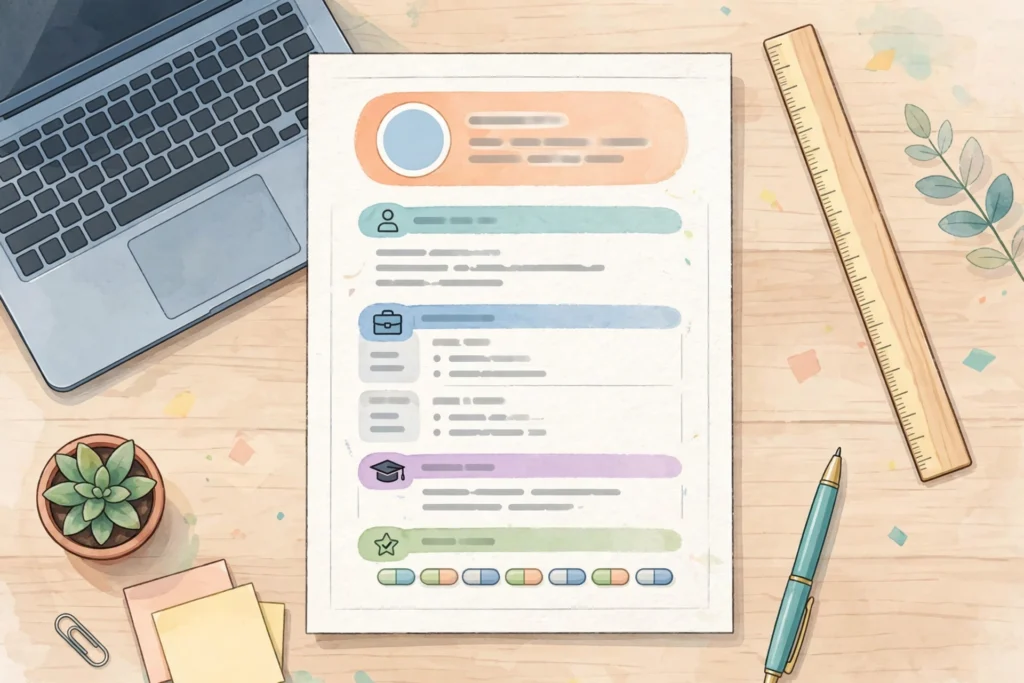
Format is not decoration on a college student resume for internship. It decides whether a screening system reads your sections in the right order at all. Use a single column, standard headings — Summary, Education, Projects, Experience, Skills — and a plain, professional font such as Calibri or Arial at 10.5 to 11 points for the body, with slightly larger bold headings. Keep margins between half an inch and one inch.
Do not use two columns, text boxes, icons for contact details, skill bars, tables for layout, or a photo header, because these elements often scramble when a system extracts your text, and your project dates can end up attached to the wrong headings. A plain file that parses correctly beats a decorative file that loses your best bullet. If you want a head start, choose a clean template that already uses one column and standard headings.
Save the file as a PDF unless the posting specifically asks for a Word document, and name the file clearly, for example Jordan_Lee_Internship_Resume_2026.pdf, using your own name and the word Internship. Before you upload anything, run the paste test on the exact file you will send: select all the text, paste it into a plain text editor, and read it in order. Your name and contact details should come first, followed by Education, Projects, Experience and Skills in that order, with dates still attached to the right entries.
If Skills jump above Education, or project dates detach from project titles, fix the layout before you apply. A one-page resume format that passes this test is the safest choice for most students, and our guide to a one-page resume for freshers explains how to cut a longer draft down to one strong page without losing your best evidence.
For a college student resume for internship, one page is the right target for almost every undergraduate applicant. If you are running over, cut in this order: first, high school entries and older activities; second, extra bullets from unrelated part-time roles; third, any skill no bullet supports. Do not shrink the font below 10.5 points to force a second page of filler onto one page. A clean one-page resume with white space looks professional.
A cramped page with tiny type looks desperate, and it is harder to read in print as well as on screen. Check the same file on a phone screen too, since a recruiter may open it there first: headings should still be clear, and no line should overflow or wrap awkwardly.
Tailor your college student resume for internship without rebuilding it
Tailoring a college student resume for internship sounds like a lot of work, but for a student it should take twenty minutes per application, not a full rewrite.
Keep one master version of your college student resume for internship with every project, bullet and skill you might use. For each posting, make a copy, then change only three things: the first project bullet, so it names a tool or task from that posting; the Skills line, reordered so the posting’s tools come first; and the summary line, so it names the internship title and your strongest matching proof.
Everything else stays the same. This keeps your applications consistent and honest, because you are reordering real evidence, not inventing new evidence for each employer.
Read the posting carefully before you change anything. Highlight three required skills or tasks you can genuinely match, and ignore requirements you cannot match — do not claim a tool you have not used. If the posting asks for a tool you used only in one lab, that lab still counts when your bullet names the scope honestly, as in the dashboard example above.
If it asks for experience you simply do not have, apply anyway when the rest of the posting fits, but do not invent it; let your projects show the closest real match, and use a short cover note to explain the connection in two sentences. A detailed guide to tailoring a resume for each job walks through this copy-and-adjust method step by step, and it is worth following for internships as well as graduate roles, because the principle is identical: mirror the posting’s language with real proof, and cut anything that does not help this specific reader.
Keep a simple record of each version you send: the employer, the internship title, the date sent, and the file name. This matters more than students expect. When a recruiter calls, you will want to know exactly which version they are looking at, and which project bullet they are likely to ask about. It also stops the common mistake of sending the wrong tailored version to the wrong employer, which is easy to do when several applications look similar. A master file plus a short application log is the whole system. You do not need complicated software to tailor well; you need discipline about changing only what the posting justifies.
Common internship resume mistakes to avoid
Several mistakes appear again and again on a college student resume for internship, and most of them are easy to fix once you see them. The first is leaving an empty Experience heading on the page. An empty heading does not read as neutral; it reads as a missing section, and it wastes space your projects could use. Rename it to Projects, or remove it until you have a paid role with dates you can defend.
The second is padding: stretching a thin history across two pages with large fonts, wide spacing, repeated skills and a long list of modules. Recruiters recognise padding instantly, and it makes the real evidence harder to find. One honest page is stronger than two padded pages.
The third mistake is claiming group work as solo work. Interviewers will ask who did what, and a vague answer undermines the whole resume. Name your component, and you can answer confidently. The fourth is using a fancy two-column template that scrambles in a screening system, so your project dates and skills arrive in the wrong order. The fifth is sending the same generic resume to every employer, with a summary that could apply to any internship in any field.
A summary that names no role, no tool and no proof helps nobody. Our guide to resume mistakes for freshers covers these traps in more detail, and most of them apply word for word to internship applications, because the cause is the same: a template used without thinking about what the reader needs to see first.
Two smaller mistakes on a college student resume for internship are worth naming because they cost interviews quietly. The first is an unprofessional email address or a broken link. Use a simple professional email, check that any portfolio or project link actually opens, and write links as plain text, not only as icons. The second is a file name such as Resume_Final_v7.pdf, which looks careless when a recruiter downloads it. Your name, the word Internship and the year are enough.
Finally, proofread the whole page aloud before you send it. Spelling and grammar errors are noticed even in a quick skim, and a university career guide lists them among employers’ top frustrations for exactly that reason. Ask a friend, tutor or career adviser to read it once as well; a second pair of eyes catches the module code, the missing date and the bullet that only makes sense to you.
Quick checklist before you send, plus a short cover note
Run this checklist for your college student resume for internship on the exact file you will upload, not on an earlier draft.
Does the first paragraph of your resume — your summary — name the internship type and one real proof point? Does Education show your degree and expected graduation clearly? Do you have two or three projects, each with dated entries and bullets that start with action verbs and name a tool and a scale or outcome? Is every skill in Skills backed by a bullet or a course?
Is the page one page, one column, with standard headings, and does it pass the paste test in the right order? Is the file a PDF, unless the posting asks otherwise, with a clear file name? Have you checked every link, every date and every spelling? If you can answer yes to each question, the resume is ready to send, even if it feels short. Short and specific beats long and vague for a first internship.
When a posting asks for a cover note or a cover letter, keep it to one page and three short paragraphs: why this employer and this internship specifically, the single most relevant project or experience and what it proves, and what you hope to learn and contribute during the term. Repeat the verb from your strongest project bullet, so the letter and the resume reinforce each other, rather than repeating the whole resume in prose.
Do not paste your resume into the letter, and do not use the letter to apologise for a lack of experience. The letter’s job is to add context the resume cannot carry — for example, why a team project matters to this employer’s work — in two or three sentences. Our guide to writing a cover letter for freshers shows how to structure that note without repeating the resume, and it is a useful companion to this guide when a posting requests one.
After you send the application for a college student resume for internship, note the date and move on to the next tailored version. Do not wait for one employer before applying to others, and do not rewrite the whole resume after every rejection.
If you are getting no replies after ten or fifteen tailored applications, review the first bullet of your strongest project and the Skills order against the postings you targeted, and ask a career adviser to read one version as a recruiter would. Small, specific changes — a tool moved into bullet one, a vague bullet rewritten with a number, a society role cut to make room for a project — usually help more than a complete redesign. A college student resume for internship improves with each round of applications, provided you keep the master file, the tailored copies and the application log together.
Frequently asked questions about a college student resume for internship
Can I write a college student resume for internship with no experience at all?
Yes, and most first-time applicants do. A college student resume for internship with no paid experience should lead with Education and Projects, not with an empty Experience section. Coursework, labs, hackathons, society work, volunteer roles and part-time jobs all count as evidence when you describe them with an action verb, a tool or method, a scale and an outcome. Do not invent a job title, and do not leave the Experience heading blank. Rename it, replace it with Projects, or cut it until you have a role with real dates.
Should a college student resume for internship be one page?
For almost every undergraduate applicant, yes. One page forces you to lead with your strongest proof and cut filler, and it matches what recruiters expect for a first internship. Use a single column, standard headings, 10.5 to 11 point body text and margins between half an inch and one inch. If you are running over one page, cut high school entries first, then extra bullets from unrelated roles, then any skill no bullet supports. Do not shrink the font to squeeze in a second page of filler.
What should I put in the summary of a student resume with no experience?
Write two lines, not a paragraph. Name your degree and year or expected graduation, name the internship type you are seeking, and add one proof point from your strongest project. For example: “Second-year business analytics student, expected graduation June 2027, seeking a data analysis internship. Built dashboards in Excel and SQL from course and hackathon projects.” Avoid generic objectives such as “seeking an opportunity to gain experience”, which tell the reader nothing they did not already assume. Resume summary examples for freshers follow the same rule: role, proof, and nothing vague.
How many projects should I include on an internship resume?
Two or three strong projects are enough. Each project should have a clear title, a context line with dates, and two bullets that name your own contribution, a tool and a scale or outcome. Six short, vague projects are weaker than two detailed ones, because a recruiter can only ask meaningful questions about work you describe specifically. If you have only one strong project, give it three bullets and support it with a relevant part-time or society role, rather than inventing a second project.
Do I need a different resume for every internship?
You need a tailored copy for every internship, not a completely new resume. Keep one master version, then copy it for each posting and change only the first project bullet, the Skills order and the summary line to match that posting’s tools and tasks. Keep a log of which version you sent to which employer, so you know what the recruiter is reading if they call. This method keeps your applications honest, because you are reordering real evidence, not creating new evidence for each employer.
Should I include part-time jobs that are unrelated to the internship?
Include an unrelated part-time job only if one bullet from it proves something the internship needs, such as reliability over time, accurate record keeping, customer communication or working under pressure. Keep it to one bullet, place it after Projects, and cut the rest of the role. If no bullet connects to the posting, leave the role out entirely. A short, relevant page is stronger than a longer page that dilutes your best project with unrelated work.
What format is best for a college student resume for internship?
A reverse-chronological, one-page, single-column format with standard headings is the safest choice for most students. List the newest entry first within each section, use plain text links, save as a PDF unless the posting asks for Word, and run the paste test before you upload. A college graduate resume format with the same structure works well after graduation too, because the habits are identical: standard headings, dated entries, action-verb bullets and a file that parses cleanly. Avoid two-column templates, text boxes and icon-only contact details for screening uploads.
How do I handle group projects honestly on an internship resume?
Name your own component in the bullet, and be ready to explain it in an interview. Write “Designed the survey and analysed responses from 86 participants” rather than claiming the whole project, and do not use “we” in a bullet that should describe your work. Interviewers probe projects in detail precisely because students have less else to discuss, so a bullet you can explain for two minutes is worth far more than a grander claim you cannot defend. Honesty here also protects you if a teammate is interviewed for the same role.
Is a free resume builder a good way to build a college student resume for internship?
A free resume builder can be a good starting point, provided it lets you control section order, use a single column, use standard headings, and export a clean PDF that passes the paste test.
Avoid any builder or template that forces a two-column layout, locks your download behind a paywall, or fills the page with graphics a screening system cannot read. Build the content first using the structure in this guide — Education, Projects, Experience, Skills — and use the builder only to format it cleanly. A simple resume creator that exports a text-based PDF is better than a decorative tool that produces a scrambled file.
When should I start applying for internships as a college student?
Start earlier than you feel ready, usually in the term before the internship term, and keep applying in parallel rather than waiting for one employer to reply. Many internship postings open months ahead, and a strong college student resume for internship can be ready before you feel fully qualified, because it is built from coursework and projects you already have. Use each application round to improve the master file: move the strongest tool into bullet one, tighten a vague bullet with a number, and cut any line no posting has asked for. The resume improves as you apply, and the applications improve as the resume improves.
A college student resume for internship does not need a long history to be convincing. It needs the right order, two or three projects described with honesty and specificity, a short skills list backed by evidence, and a clean one-page format that a recruiter and a screening system can both read without effort.
Build the master version once, tailor a copy for each posting by changing bullet one, the skills order and the summary, and check the exact file you send with the paste test and the checklist above.
That is how a student resume with no experience stops looking empty and starts looking like a strong, interview-ready application. Start with your strongest project tonight, rewrite its first bullet with a tool from a real posting and a concrete scale or outcome, and you will have the hardest part of your college student resume for internship done before you apply for anything else.
1 thought on “College Student Resume for Internship: Perfect Guide 2026”